

May 11, 2025
Source: Web Hispania
Medicine in the territories of the Spanish Monarchy between the 15th and 17th centuries underwent a profound transformation. The convergence of European, Indigenous, and African knowledge systems gave rise to a plural medical landscape marked by tensions between religion, imperial governance, and the institutionalization of science. This article synthesizes several historical studies exploring this process through multiple lenses: the legal and academic consolidation of medicine, the role of religious orders, interaction with local healing systems, doctrinal surveillance, and the material evolution of healthcare practices. Together, these perspectives offer a comprehensive view of medicine as a political, spiritual, and intellectual practice in a globalizing world.
A World in Transition: From Renaissance to Overseas Expansion
Spanish medicine at the end of the 15th century was being reshaped alongside the dynastic union of Castile and Aragon and the expansion of the Spanish Crown into the Americas. As Luis S. Granjel notes, the creation of the Protomedicato helped consolidate medicine as a legally regulated profession under royal authority.
Simultaneously, Renaissance humanism and the thought of Erasmus of Rotterdam influenced many Spanish physicians. Alfredo de Michell demonstrates that prominent doctors in Spain and New Spain, such as Pedro López and Juan de la Fuente, owned Erasmian texts including Adagia and Paraclesis, which promoted a medicine rooted in ethics, observation, and inner Christian virtue.
Medicine and Evangelization in the Realms of the Spanish Monarchy
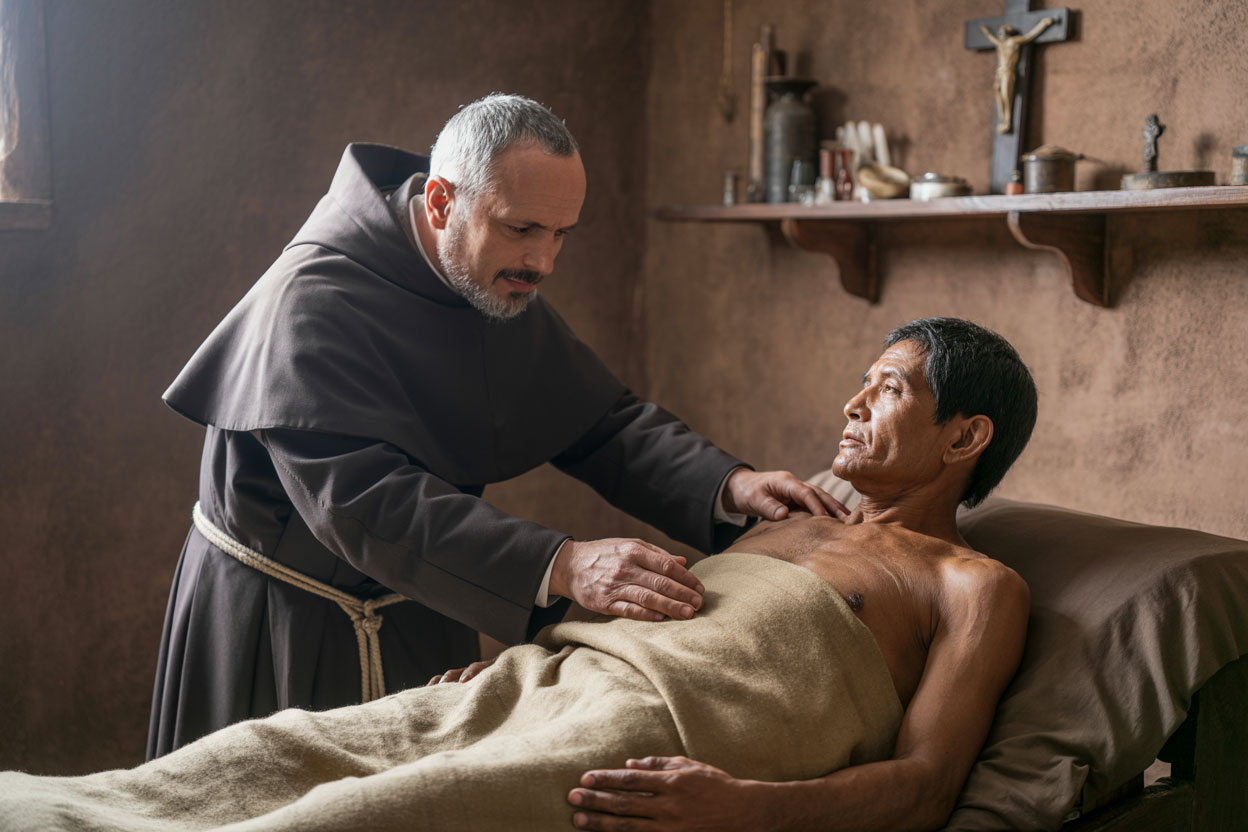
AI-generated representation of a Spanish friar treating an Indigenous patient in a modest room, inspired by the historical role of religious orders in evangelizing through healing. The presence of the crucifix, shelves, and subdued light evokes a moment of intimate spiritual care.
Following the incorporation of American territories into the Crown of Castile, medicine became an instrument of spiritual and political integration. As shown by José Pardo-Tomás in his study of Fray Agustín Farfán, the Augustinian friars used healing not only to cure bodies, but also to convert souls, embodying what the author calls a “medicine of conversion”.
Farfán practiced medicine in a context of epistemic plurality, where Indigenous remedies, African traditions, and European theories coexisted. His role was not merely to impose Spanish practices, but to engage in a continuous negotiation of knowledge systems. The result was a syncretic medical culture where healing, evangelization, and the reordering of social relations converged.
Institutionalization of Medical Practice in the Spanish Realms
Gerardo Martínez Hernández explains that the institutional consolidation of medicine in the Americas unfolded through two main bodies: the Royal and Pontifical University of Mexico, and the Protomedicato, which was charged with licensing and regulating practitioners.
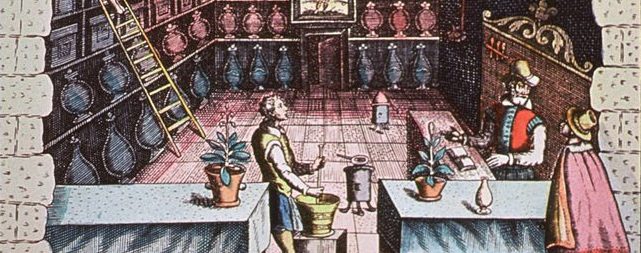

Beginning in the 1570s, this framework enabled the rise of a creole medical elite educated in Galenic doctrine and committed to public regulation. Figures like Francisco Hernández, royal physician and scientific envoy of Philip II, played key roles in systematizing natural knowledge from the Americas. His work represents not a colonial appropriation, but a reinterpretation and systematization of local healing knowledge within European scientific frameworks, often detaching it from its original symbolic meaning.
Surgeons, Inquisitors, and Heretics: Medicine and Ideological Control
Medical practice also operated under religious scrutiny. Alfredo de Michell-Serra presents cases of physicians prosecuted by the Holy Office of the Inquisition, not only for heresy, but also for engaging in forms of medical empiricism or innovation considered suspicious.
Among these was William Corniels, an Irish Protestant surgeon captured in Central America, and Enrique Esteban Morel, a physician accused of Enlightenment sympathies in the 18th century due to his support for smallpox inoculation. These episodes reveal that medicine functioned within a framework of ideological conformity, where healing was expected to align with religious orthodoxy and loyalty to the Crown.
Plants, Knowledge, and Secrets: A New Medical Landscape
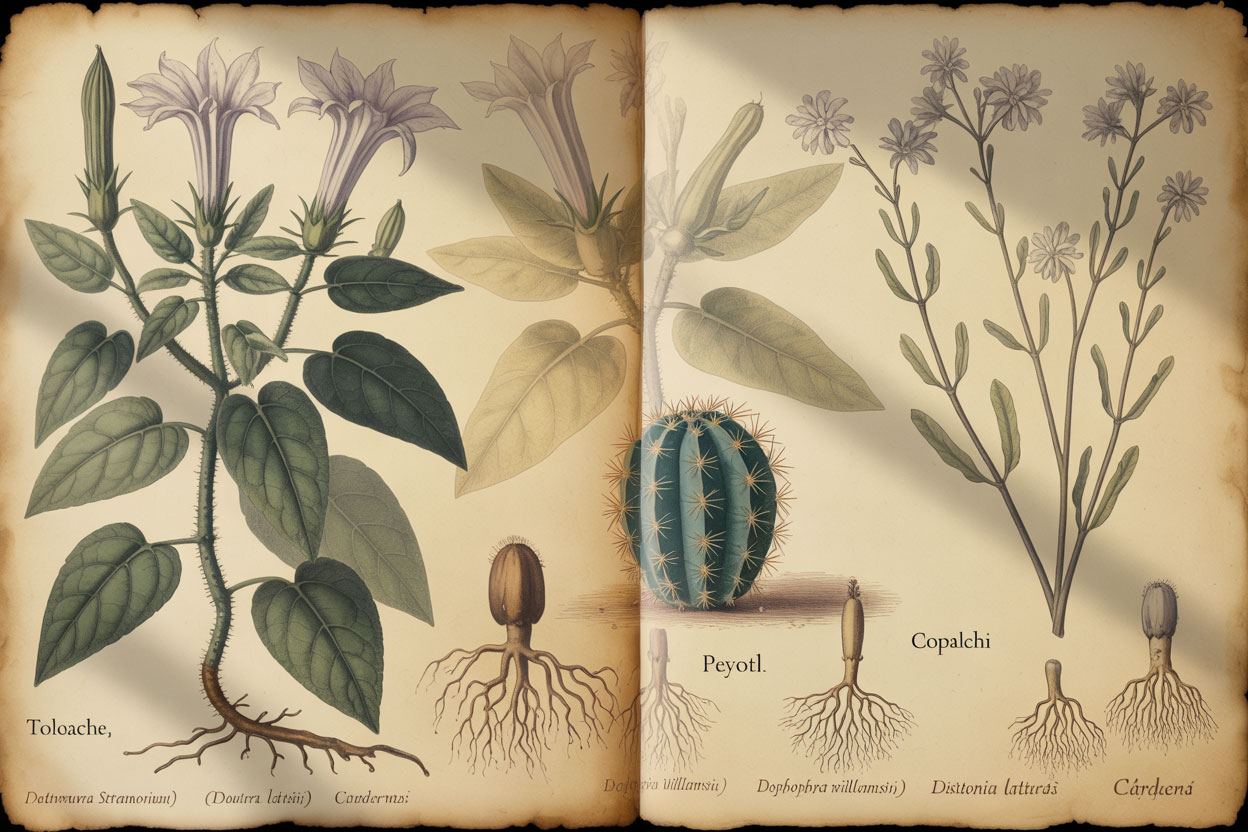
Artificially generated botanical illustration showing Toloache (Datura stramonium), Peyotl (Lophophora williamsii), and Copalchi (Hintonia latiflora), based on early modern herbal sources. The roots, leaves, and flowers are rendered in the style of 16th–17th century field herbals.
In Problemas y secretos maravillosos de las Indias (1591), Juan de Cárdenas documents the ritual and medicinal use of plants such as toloache and peyote. As analyzed by Matías Álvarez, Cárdenas’s discourse combines empirical curiosity with moral caution, classifying Indigenous botanical practices as powerful but potentially dangerous.
Rather than appropriating these practices, early modern scholars in the Americas sought to reframe and adapt local pharmacological knowledge to align with Galenic and European scientific principles. This process, though often dismissive of original cultural meanings, contributed to the emergence of a transatlantic materia medica, rooted in the realities of the Spanish Monarchy’s diverse territories.
Infrastructure and Materiality: Hospitals and the Bed
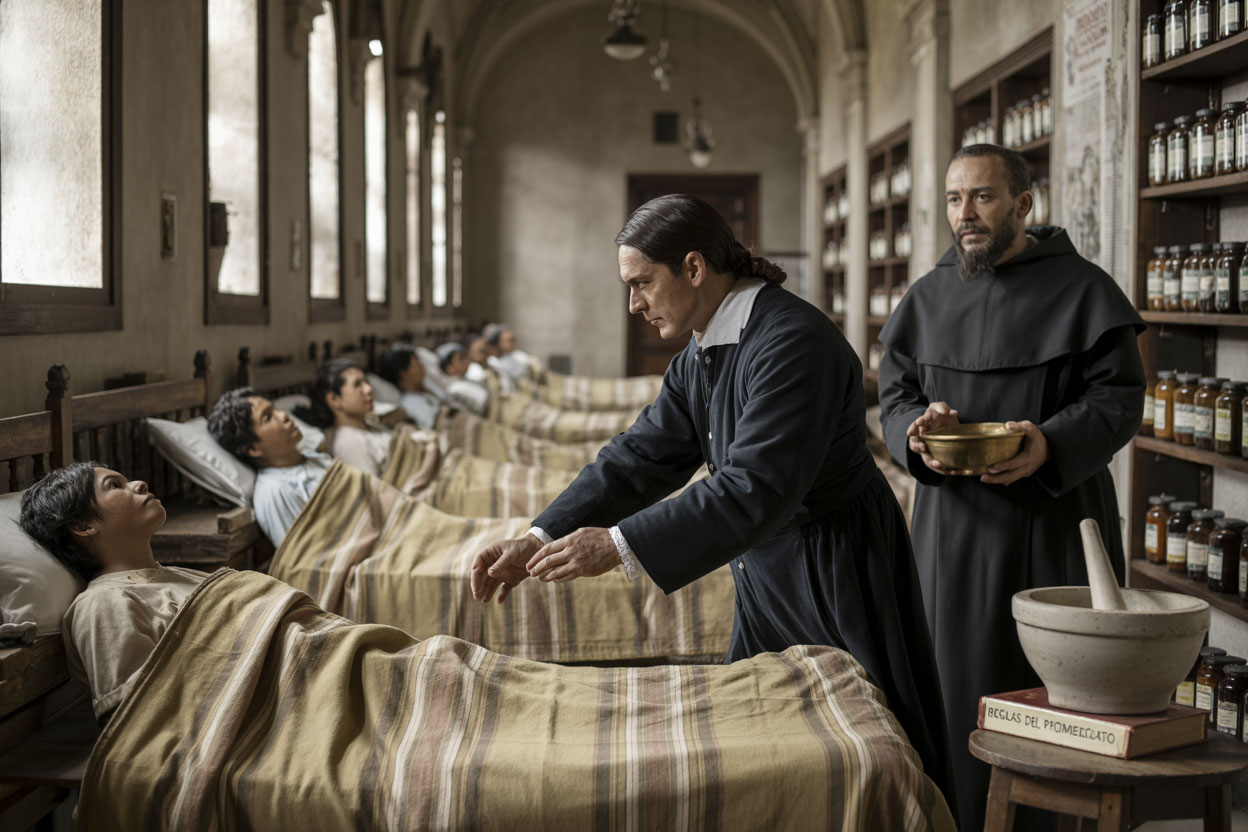
AI-generated image depicting a 17th-century hospital ward in New Spain. A creole physician examines a mestizo patient while a friar assists nearby. Rows of beds, labeled jars, and a book marked “Reglas del Protomedicato” evoke the institutional and moral landscape of early modern medicine.
The development of hospitals throughout the Spanish territories reflected broader shifts in medical care. Guillermo Fajardo-Ortiz and Germán Fajardo-Dolci trace the evolution of the hospital bed as a symbol of institutional care—from makeshift arrangements to structured clinical environments.
Hospitals in cities such as Mexico City and Lima became multiethnic spaces of healing and discipline, combining Christian charity with administrative oversight. The hospital bed, as both a physical and symbolic structure, reflects the ways in which medicine, spirituality, and social control were entangled in the everyday life of the Spanish Monarchy’s territories.
A Mestizo and Supervised Medicine
As these studies demonstrate, medicine in the Hispanic world was not a monolithic or purely European science, but rather a composite cultural practice, shaped by legal, religious, and epistemic forces. Physicians, friars, surgeons, and administrators navigated multiple knowledge systems, crafting a tradition that was plural, contested, and closely monitored.
Far from being a passive extension of metropolitan science, the medical systems that developed in the Americas during the early modern period formed part of a distinctive Hispanic tradition, marked by the interaction of official doctrine, local realities, and global knowledge flows. This legacy continues to influence Latin American medicine today, in the coexistence of biomedical, traditional, and spiritual healing systems.
Sources
- Granjel, L. S. (1971). La medicina española en la época de los Reyes Católicos. Revista de Medicina General e Historia.
- De Michell, A. (s.f.). Influencias erasmianas en médicos renacentistas.
- De Michell-Serra, A. (s.f.). Cirujanos y médicos frente a la Inquisición Novohispana.
- Pardo-Tomás, J. (2014). Pluralismo médico y medicina de la conversión: Fray Agustín Farfán y los agustinos en Nueva España, 1533–1610. Hispania, Vol. LXXIV, Nº 248, pp. 749–776.
- Martínez Hernández, G. (2014). La medicina en la Nueva España, siglos XVI y XVII. Consolidación de los modelos institucionales y académicos. UNAM.
- Álvarez, M. (2014). Las plantas psicotrópicas americanas en la obra de Juan de Cárdenas. Fronteras de la Historia, Vol. 19, Nº 2, pp. 14–36.
- Fajardo-Ortiz, G., & Fajardo-Dolci, G. (s.f.). Historia de la cama de hospital. Investigación en diversos lugares y tiempos.
Share this article
On this day
No Events
History of Spain