


October 29, 2025
Source: Web Hispania
In 2023, Hispanic Executive published an article promoting Latinx and Latine as “inclusive” alternatives to Hispanic or even Latino—and repeating the old myth that Spain’s conquest of the Americas caused “the largest genocide in history.” This response challenges both claims, exposing the ideological bias behind them and defending the historical, linguistic, and cultural legitimacy of the Hispanic identity against the latest wave of Anglo-American cultural impositions.
In July 2023, Hispanic Executive magazine published an article titled A Brief Explainer on Latine and Latinx. In it, these neologisms were presented as the “most inclusive” terms to refer to communities of Latin American origin in the United States. At the same time, the piece uncritically repeated the myth that the conquest of the Americas amounted to “the greatest genocide in history,” invoking the magical figure of 56 million Indigenous people killed.
It is striking that a publication whose stated mission is to “close the opportunity gap” and “uphold the highest standards of quality” would disseminate figures without historiographical support and concepts imported from the Anglo-American academy—ideological rather than scholarly. From a Hispanic perspective, it is worth responding with historical, linguistic, and cultural rigor.
After all, if the goal is to “inspire and connect” Hispanic executives in the United States, the first step should be to respect their real history and their language—not to promote distorted narratives that reinforce clichés and weaken identities.
The Myth of the “56 Million”
The claim that “56 million” Indigenous people died—presented in the Hispanic Executive article as unquestionable fact—is actually an inflated speculation born in the 1960s. Researchers such as Sherburne F. Cook and Woodrow Borah proposed extremely high estimates of pre-Columbian population and a subsequent drastic collapse after European contact. Yet those figures lack solid documentation: they are retrospective calculations based on highly fragile demographic assumptions.
Historian David Henige, in his book Numbers from Nowhere: The American Indian Contact Population Debate (1998), summed it up bluntly: such figures have been repeated again and again without any criticism, until they became a political dogma rather than an academic conclusion. Henige denounced the “mathematical credulity” of those who turn mere hypotheses into unquestionable certainties.
There is no serious historiographical consensus supporting the figure of “56 million,” let alone the idea that the conquest of the Americas constituted “the greatest genocide in history.” Such language belongs to the realm of militant rhetoric, not rigorous historical research.
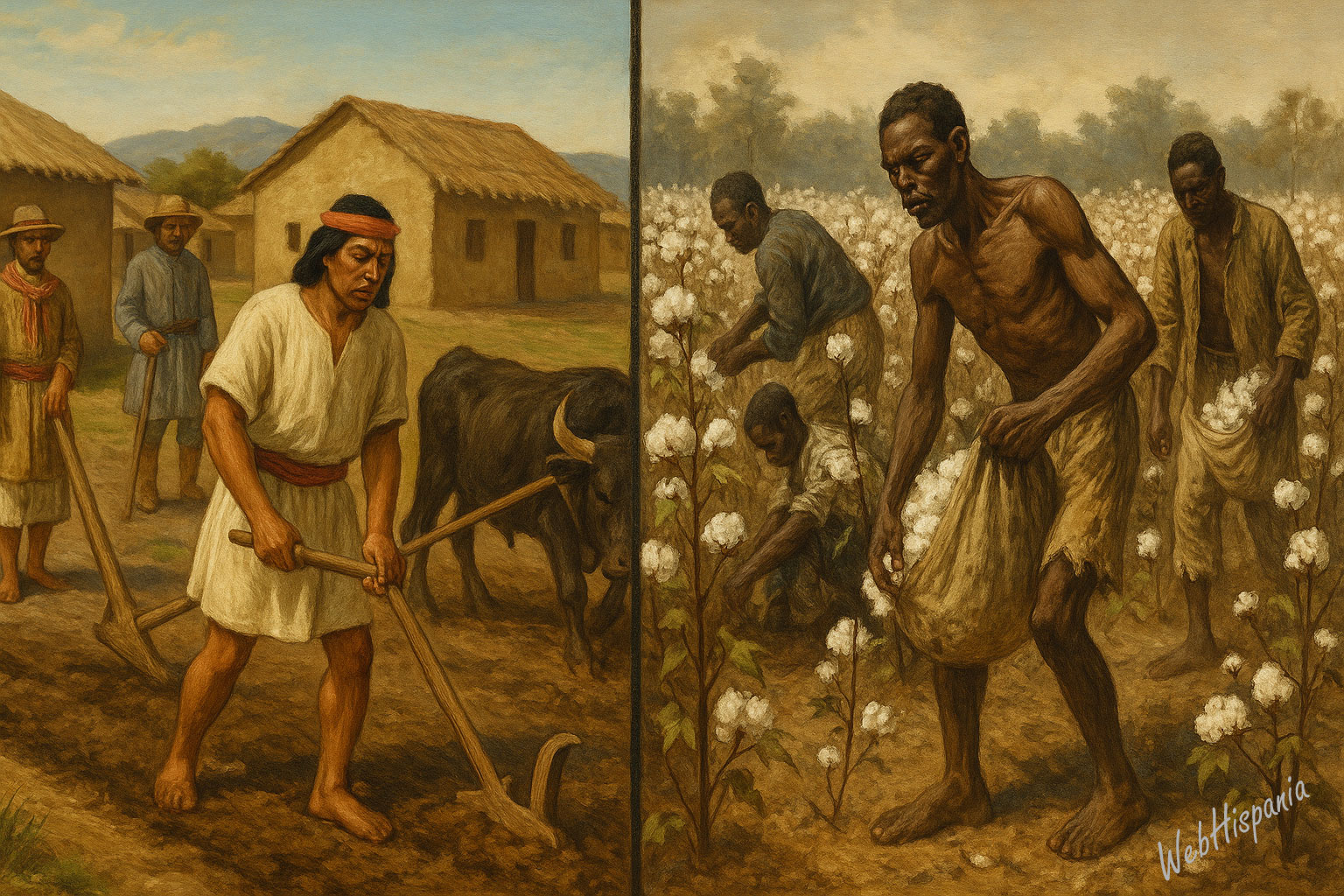
It should be remembered that deaths in the Americas resulted from multiple factors, with unintentional epidemics being by far the most decisive and devastating—something even contemporary chroniclers acknowledged. To attribute all mortality to a so-called “Spanish genocide” is not only historical manipulation but also an insult to the complexity of the demographic and cultural processes that unfolded after 1492.
Latinx/Latine: An Anglo-Saxon Product Meant to Erase Identities
The Hispanic Executive article presents Latinx and Latine as the “most inclusive” terms for describing people of Latin American descent in the United States. The reality is quite different: these are concepts created and spread within Anglo-American academic and activist circles that have almost no roots in the Spanish-speaking world. They are not the result of an organic process within Hispanic communities, but of external linguistic engineering seeking to impose categories alien to the Spanish language.


The term Latinx emerged in U.S. university environments in the early twenty-first century, modeled on the English suffix “-x” used to neutralize gender. The problem is obvious: Spanish, unlike English, has a distinct morphology and has for centuries used the vowel -e as a naturally inclusive and neutral ending in words such as estudiante, cliente, and dirigente. For millions of native speakers, therefore, Latinx is unpronounceable and artificial—a reverse form of colonialism, an attempt to impose on Spanish a solution devised for another language.
The variant Latine tries to solve this problem, presenting itself as a “more natural” alternative for Spanish speakers. Yet it too is an imported invention, promoted in conferences, NGOs, and cultural-studies departments that seldom reflect the real speech of Hispanic peoples. Unsurprisingly, most surveys show overwhelming rejection: according to the Pew Research Center (2020), only about 3 percent of U.S. Hispanics identify with the label Latinx, while the vast majority continue using Hispanic or Latino.
The contradiction is glaring. Sixteenth-century Spaniards are accused of “imposing their language and culture,” yet today there is a push—again from English-speaking academia—to impose new labels that meet no real need. This is genuine cultural colonialism in contemporary form, operating with a clear goal: to erase historical identities—Hispanic and Latino—that refer to a shared heritage of language, faith, and civilization.
Ultimately, neither Latinx nor Latine represents the peoples of Spanish- and Portuguese-speaking America. These are ideological categories, designed to fragment and dilute an identity that has endured for centuries, replacing it with a conceptual contrivance born of internal U.S. activist debates rather than the lived reality of millions of Hispanics.
The Contempt for “Hispanic”
One of the most striking aspects of the Hispanic Executive article is its insistence on portraying the term “Hispanic” as “offensive” or “insulting.” This claim not only lacks any factual basis but flatly contradicts the experience of millions who proudly identify as Hispanic. The magazine’s own name—Hispanic Executive—illustrates the incoherence: how can a publication that claims to represent Hispanics disparage the very word emblazoned on its cover?
The term Hispanic has a far deeper historical root than its modern substitutes. It derives from Hispania, the Roman name for the Iberian Peninsula—the birthplace of the language and culture that flourished across the Americas. By contrast, Latin America is a French invention of the nineteenth century, coined under Napoleon III to justify his intervention in Mexico. The notion of “Hispanic,” on the other hand, is grounded in genuine linguistic and cultural continuity. In short, Hispanic is not a geopolitical artifice but the expression of a tangible historical inheritance.
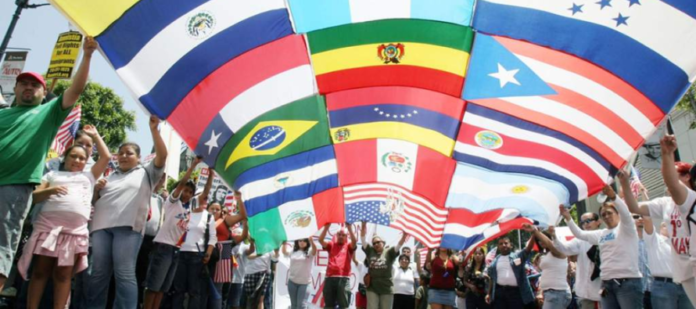
Moreover, the term remains fully alive in the United States. Movements such as “We Are Hispanic,” the official celebration of Hispanic Heritage Month, and the word’s constant use by politicians of both parties all demonstrate that, far from being obsolete or “colonial,” it is a living and unifying element of identity. Even Donald Trump, in several rallies, spoke of “great Hispanics” as an essential part of the American nation.
In light of this, the attempt to erase “Hispanic” and replace it with labels like Latinx or Latine is not an act of inclusion but of cultural annihilation. It means displacing a historical, shared identity for another that—under the guise of neutrality—fractures and fragments. This contempt for the Hispanic name ultimately reveals a deeper fear: the fear of acknowledging that Hispanidad is one of the most enduring and foundational roots of U.S. society.
Real Identities vs. Linguistic Engineering
The paradox of this debate is that those most eager to impose new labels are precisely those most detached from the daily life of Hispanics. In reality—throughout both Latin America and the United States—people identify in concrete ways: Mexican, Peruvian, Dominican, Cuban, Colombian… These national and regional identities are the ones with genuine historical and cultural grounding.
Broader categories like Hispanic or Latino serve practical purposes—censuses, public policy, political representation—or simply highlight a shared heritage in the U.S. context. They are terms adopted organically by the community itself, not imposed from above.
By contrast, Latinx and Latine exemplify linguistic engineering: attempts to redesign language and identity in ideological laboratories far removed from Hispanic reality. They are not living expressions born of the people and their tongue but constructions crafted to fit specific academic and political agendas. Their artificiality is evident in their widespread rejection and their impracticality in everyday speech.
Under the banner of “inclusion,” what is actually promoted is fragmentation. A historically and culturally robust identity—the Hispanic one—is diluted in favor of neologisms that neither unite nor represent, but rather divide and confuse. Beneath it all lies a clear ideological motive: to replace Hispanic roots with a fluid, malleable category detached from real history, one that can be more easily absorbed into the Anglo-American cultural framework.
Conclusion
The Hispanic Executive article is a clear example of how certain elites seek to rewrite our history and identity through alien frameworks. First by inflating undocumented numbers to portray the conquest of the Americas as “the greatest genocide in history,” and then by attempting to replace living, time-honored terms—Hispanic, even Latino—with ideological neologisms manufactured in Anglo-American think tanks.
To those who claim to represent us, it must be said: the Hispanic identity needs neither tutelage nor imposed neologisms. Hispanidad is a historical, cultural, and linguistic reality that has endured for centuries and will continue as long as millions recognize themselves within it. What threatens this identity is not a supposed lack of inclusivity, but the cowardice of those who, in the name of modernity, bend the knee to Anglo-American impositions.
Stop trying to mold us into what others want us to be. Stop wanting us to become what Anglo-Americans expect us to be. The true strength of our community lies in recognizing what we already are: heirs to a Hispanic tradition that gives us language, memory, culture, and future.
Share this article
On this day
- 912 Reconquista: In Cordoba, Abderraman III is proclaimed emir. He will take the Cordoba emirate to its highest political and religious expression: the caliphate.
- 1780 Spanish cartographer Bernardo de Miera publishes the first map showing all the waters, mountain ranges and deserts between Rio Grande and Arkansas river.
History of Spain