


July 29, 2025
Source: Web Hispania
“Kill everyone over ten.” —Maj. Gen. Jacob H. Smith, order during the Samar campaign, 1901
On 29 December 1890 the 7th Cavalry massacred hundreds of Lakota at Wounded Knee, symbolically closing the “Conquest of the West”. Nine years later many of those same veterans sailed across the Pacific to occupy the Philippines. There they reproduced the same tactics—encirclements, artillery fire, summary executions—now backed by industrial fire-power and far from the gaze of the U.S. press. This essay (≈ 8 000 words) traces that line of continuity and compares it with three centuries of Spanish rule.
Manifest Destiny and “the white man’s burden” went global in 1898: the United States inherited the Philippine Islands from Spain, along with a population of some seven million little brown brothers. Scientific racism—Herbert Spencer, Social Darwinism—placed Filipinos on the same sub‑human rung as the Indigenous peoples of North America. Occupation was therefore conceived as a natural extension of the Indian wars.
The Lakota massacre was no anomaly; it was the epilogue to forty years of scorched‑earth campaigns. The pattern consolidated in 1890 (forced disarmament, an “accidental” shot, indiscriminate fire, an official self‑defence narrative) would be exported intact to the Philippine archipelago.
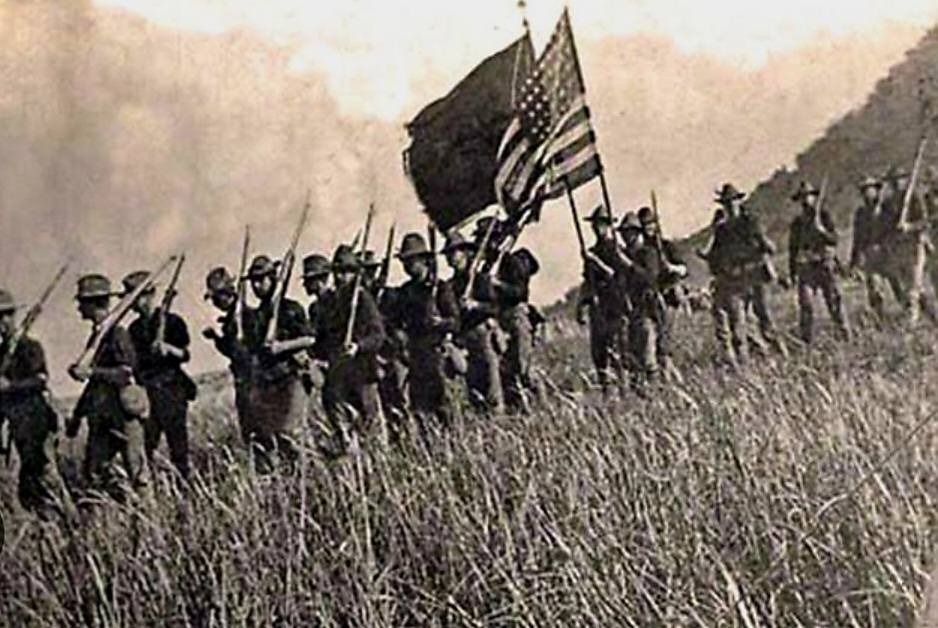
U.S. troops advance toward the Maranao fortress of Pandapatan during the 1902 “Padang Karbala” campaign.
Four Filipino episodes that replicate—and surpass—the frontier logic
Padang Karbala (Battle of Bayang, 2‑3 May 1902)
Colonel Frank Baldwin led 1 700 troops against the fortress of Pandapatan, held by only a few hundred Maranao; between 300 and 400 defenders were killed versus ten U.S. dead.
After the battle, the Maranao buried their dead inside the fortress walls and forbade any outsider to enter without removing their shoes. To this day elders recite epic verses (darangen) portraying the Sultan as a martyr akin to Husayn at Karbala. Every 3 May a kandori (ritual feast) honours “those who did not kneel”, turning the site into both shrine and oral archive.
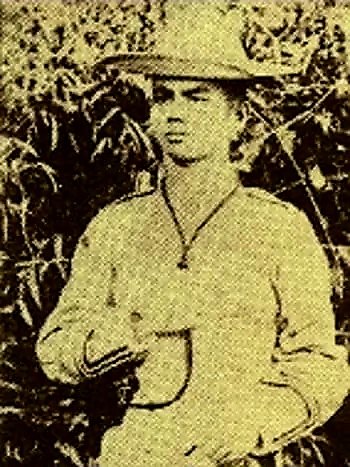
Isabelo “Bikong” del Rosario, violinist-turned-captain who was hanged in Pampanga on 12 April 1901 after refusing U.S. amnesty.
The last dance of Kapitan “Bikong” del Rosario (12 April 1901)
The 22‑year‑old revolutionary violinist played a Danza Habanera Filipina on the gallows before his execution in Mexico, Pampanga.
The echo of that violin spread far beyond the plaza. Contemporary chronicles say several kundiman orchestras in San Fernando performed Bikong’s piece at funerals and clandestine soirées, making it an unofficial hymn of Kapampangan resistance. In 1935 the young composer Antonino Buenaventura wove passages of the melody into his famous Pandanggo sa Ilaw, sealing the link between popular art and insurgent memory.

The crater of Bud Dajo (5‑8 March 1906)
Seven‑hundred‑and‑fifty troops surrounded a dormant volcano sheltering about 1 000 Tausūg—mostly women and children; only six survived.
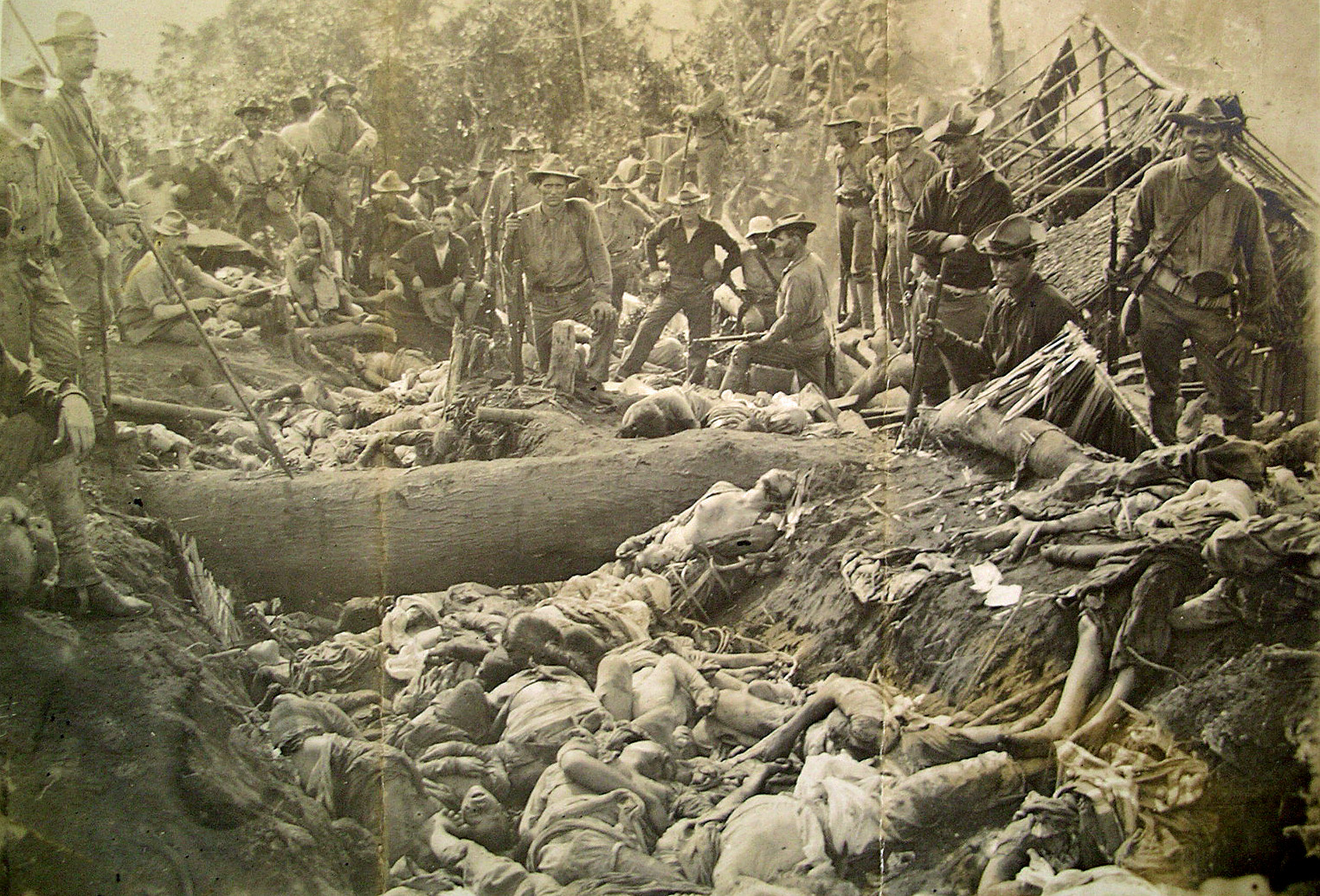
Aftermath of the Bud Dajo massacre, Jolo Island, March 1906: U.S. troops pose above a trench filled with Moro casualties.
Outrage crossed the ocean. Mark Twain sent a blistering letter to the North American Review denouncing that “we have civilized a thousand corpses”. The U.S. Senate opened an inquiry, yet Filipino witnesses were barred and the photographs filed under military seal until the 1970s. That official silence explains why, unlike Wounded Knee, Bud Dajo remains a blank space in U.S. school textbooks.
“Turn Samar into a howling wilderness” (1901‑1902)
After the Balangiga ambush, General Jacob H. Smith ordered his men to kill every male over ten years of age.
Smith’s order was no mere threat: battalions of the 11th Infantry burned crops, poisoned wells and herded civilians into concentration zones. Military maps marked razed villages with the initials “P.I.” (Provisional Indemnification), a euphemism hiding depopulated hamlets and hundreds of makeshift graves. Smith faced court‑martial, was forced into retirement, yet kept his pension and never expressed remorse.
General Licerio Gerónimo reorganised his Morong Battalion into hill bands that harassed U.S. supply lines and shot General Henry W. Lawton at San Mateo (19 December 1899). The response was the reconcentration of civilians and the torture known as the water cure. This practice forced prisoners to ingest large quantities of water through a funnel or bamboo tube until the abdomen swelled; guards then pressed the stomach or chest to induce violent vomiting, only to start again. The result was unbearable pain, a sensation of drowning and, not rarely, death by gastric rupture or asphyxiation. Seen as the direct ancestor of modern waterboarding, the water cure was denounced before the U.S. Senate in 1902 but continued in campaigns like Samar under the euphemism of “rigorous interrogation”.
Comparative colonial mortality
| Power | Period | Documented directed deaths |
| Spain | 1565-1898 (333 years) | ≈ 50 000 (combatants & civilians; conservative estimate centred on major uprisings—Sangley 1603/1639, Dagohoy, Spanish‑Moro wars) |
| United States | 1899-1913 (14 years) | 200,000 – 1,000,000 Filipinos (20,000 combatants + 180,000‑980,000 civilians from combat, reconcentration, famine and epidemics) |
| Comparative colonial mortality | ||
Annual death density: Spain ≈ 150 deaths/year · U.S. ≈ 14 000‑71 000 deaths/year.
Even allowing for the inevitable under‑reporting of the Spanish era, the annual mortality rate under U.S. occupation is two orders of magnitude higher.
Dehumanising the enemy made annihilation acceptable. Kipling versified it; President Roosevelt praised it; counter‑insurgency manuals systematised it.
Capitol Hill opened formal inquiries only when the press leaked photographs of Bud Dajo. Smith was cashiered but not convicted. In U.S. textbooks the “Insurrection” merits a single paragraph; in the Philippines each town preserves the names of its martyrs.
Estimates range from 200,000 to 1,000,000 Filipino deaths, depending on whether one includes epidemic victims inside reconcentration camps and the harvest collapse. Current historiography hovers around half a million, but recent studies—G. B. C. Bernstein (2013); D. Kramer (2019)—raise the figure to one million.
It is worth stressing that this violence in the Philippines fits a pattern already rehearsed by the nineteenth‑century Anglo‑Saxon empires: from the near‑extermination of the Palawa people in Tasmania (1824‑1831) to the “wars of extinction” against Australian Aboriginal nations and the Māori, or the chaotical division of India which cost one million deaths. In every case the premise was identical—only the white Protestant man was deemed fully human—and the colonial powers exported that conviction overseas through encirclements, induced famines and campaigns of annihilation.
- Imperial continuity: from Dakota to Bud Dajo the logic of warfare is identical.
- Structural racism: the “sub‑human” label authorises orders of extermination.
- Selective memory: what is not taught is easily repeated.
- Cultural resistance: Maranao, Tausūg and Kapampangans keep the names of the fallen as a political act.
Conclusion
Wounded Knee was not an epilogue; it was a prologue. The frontier never ended in Dakota or in Manila: it persists wherever power deems the lives of the occupied expendable. Recognising the continuity between the conquest of the prairies and the Philippine “pacification” is the first step toward preventing genocide from being normalised—yesterday on a Mindanao volcano, tomorrow perhaps in another periphery of empire.
Sources
- Bernstein, G. B. C. “Counting Corpses: Re-examining the Filipino Death Toll in the Philippine–American War.” Journal of Pacific History 48, no. 3 (2013): 321-345.
- Brown, Dee. Bury My Heart at Wounded Knee: An Indian History of the American West. New York: Holt, 1970.
- Hagedorn, Hermann. Leonard Wood: A Biography. 2 vols. New York: Harper & Brothers, 1931.
- Kramer, Paul A. The Blood of Government: Race, Empire, the United States, and the Philippines. Chapel Hill: University of North Carolina Press, 2006.
- Linn, Brian McAllister. The Philippine War, 1899-1902. Lawrence: University Press of Kansas, 2000.
- Miller, Stuart Creighton. “Benevolent Assimilation”: The American Conquest of the Philippines, 1899-1903. New Haven: Yale University Press, 1982.
- Senate Committee on the Philippines, 57th Cong., 1st sess. Hearings before the Senate Committee on the Philippine Islands, 1902. Washington, DC: Government Printing Office, 1902.
- Twain, Mark. “Comments on the Moro Massacre.” North American Review 182 (May 1906): 640-644.
- Utley, Robert M. The Last Days of the Sioux Nation. New Haven: Yale University Press, 1963.
- Williams, George Washington. “An Open Letter to His Serene Majesty Leopold II, King of the Belgians, and Sovereign of the Independent State of Congo.” New York, 1890.
A heartfelt thank-you to Whispered Words—whose carefully curated Facebook stories first led me down this lesser-known path of Philippine history. Your posts lit the spark that became this article, proving once again how community storytelling can rescue voices that official archives overlook.
Share this article
On this day
- 912 Reconquista: In Cordoba, Abderraman III is proclaimed emir. He will take the Cordoba emirate to its highest political and religious expression: the caliphate.
- 1780 Spanish cartographer Bernardo de Miera publishes the first map showing all the waters, mountain ranges and deserts between Rio Grande and Arkansas river.
History of Spain