


Source:
Source:ABC
OIn the name of Philip II, the Asturian Pedro Menéndez de Avilés arrived in the summer of 1565 on the coast of Florida, a territory that occupied not only the current state of that name but the two Carolinas, part of Alabama and all of Georgia. The emissary’s instructions were to expel the French, who were also seeking a lasting settlement in the area, and populate the east coast of what is now the United States, a territory that had resisted against Juan Ponce de León, Pánfilo de Narváez, Hernando de Soto and many others due to the hostility of the natives and the difficulty of bringing supplies to their few natural ports.
In his persecution of the French, Menéndez de Avilés took possession of a place with good natural conditions (60 kilometers south of Jacksonville) in the name of the King of Spain and founded San Agustín de la Florida there, whose existence continues to this day as the oldest city in the current US All this under the gaze of many indigenous people, who were invited to a meal with the Europeans that can be considered a direct antecedent of what is known today as Thanksgiving Day.
In addition to San Agustín, the Spanish founded several more defensive posts in Florida, including San Mateo, in what had been a French fort. However, the conditions of this land and the premature death of the advance, in 1574, forced the colonists to assume a defensive strategy. The Spaniards of this network of forts ended up retreating to San Agustín, which also suffered the unspeakable; among other evils, the bombardment of the British pirate Francis Drake, who devastated the city taking advantage of the betrayal of two of its inhabitants. It endured everything from the castle of San Marcos, still standing, without giving up for more than two centuries of existence as an outpost of the Spanish Empire.
The conditions of this land and the premature death of the advance in 1574 left the colonization of Florida incomplete.
In 1763, by means of the Treaty of Paris, the Spanish Crown ceded San Agustín and the lands with Franciscan missions to the English, so that the population was evacuated and the friendly Indians were transported to Santo Domingo, where they were integrated into the mestizo society. For a short period of time, La Florida (eastern and western Florida) returned to the hands of Spain by the Treaty of Versailles (1783), until, finally, an American invasion forced a weakened Spain to surrender this territory, in 1821, in exchange for five million dollars, which were used to pay pending claims between the two countries. The ceremony of change of sovereignty was held on July 10 of that year in the Plaza de la Constitución in San Agustín, lowering the Spanish flag with the colors red and yellow.
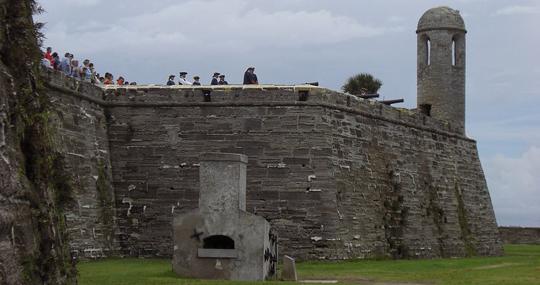
Cannons of the Castillo de San Marcos.
As the video from The Hispanic Council recalls, the inhabitants of San Agustín never forgot their Spanish past, of which there are permanent vestiges in the urban landscape and it is even remembered every year with a program of celebrations around the figure of Avilés. Their neighbors remember the exploits of their ancestors with a parade with people in period clothes.
One Comment
Leave A Comment
You must be logged in to post a comment.
Share this article
On this day
- 1690 The excellent Baroque painter Juan de Valdés Leal, nemesis of Murillo and famous for his "Vanitas" in the Hospital de la Caridad, dies in Sevilla.
- 1940 At dawn, Lluís Company y Jover, President of the Generalitat de Catalunya, is shot by a picket of soldiers at Montjuic Castle for the crime of military rebellion.
History of Spain

[…] Spanish convoy system, whose theorist was captain Menéndez de Avilés, would be copied by England and the United States in the two world wars. But the true proof that it […]