

August 13, 2025
Source: Web Hispania
“If Only the British Had Colonized Us”
It’s a phrase that circulates with a mixture of naïveté and historical resentment, especially on social media and in shallow talk shows. The underlying idea is that British rule would supposedly have brought more prosperity than Spanish rule.
But the data says otherwise. The International Monetary Fund (IMF), in its 2024 statistics, offers us an X-ray of the world today: of the 50 poorest countries on the planet, not a single one was a overseas Spanish province. In contrast, former colonies of the United Kingdom, France, Portugal, and Belgium abound.
This contrast is no accident. It is not merely a matter of geography or luck, but of the fundamentally different nature of the imperial projects.
Generative Empires vs. Predatory Empires
The key difference between the Spanish Empire and other colonial models lies in the legal and moral status given to the peoples it incorporated.
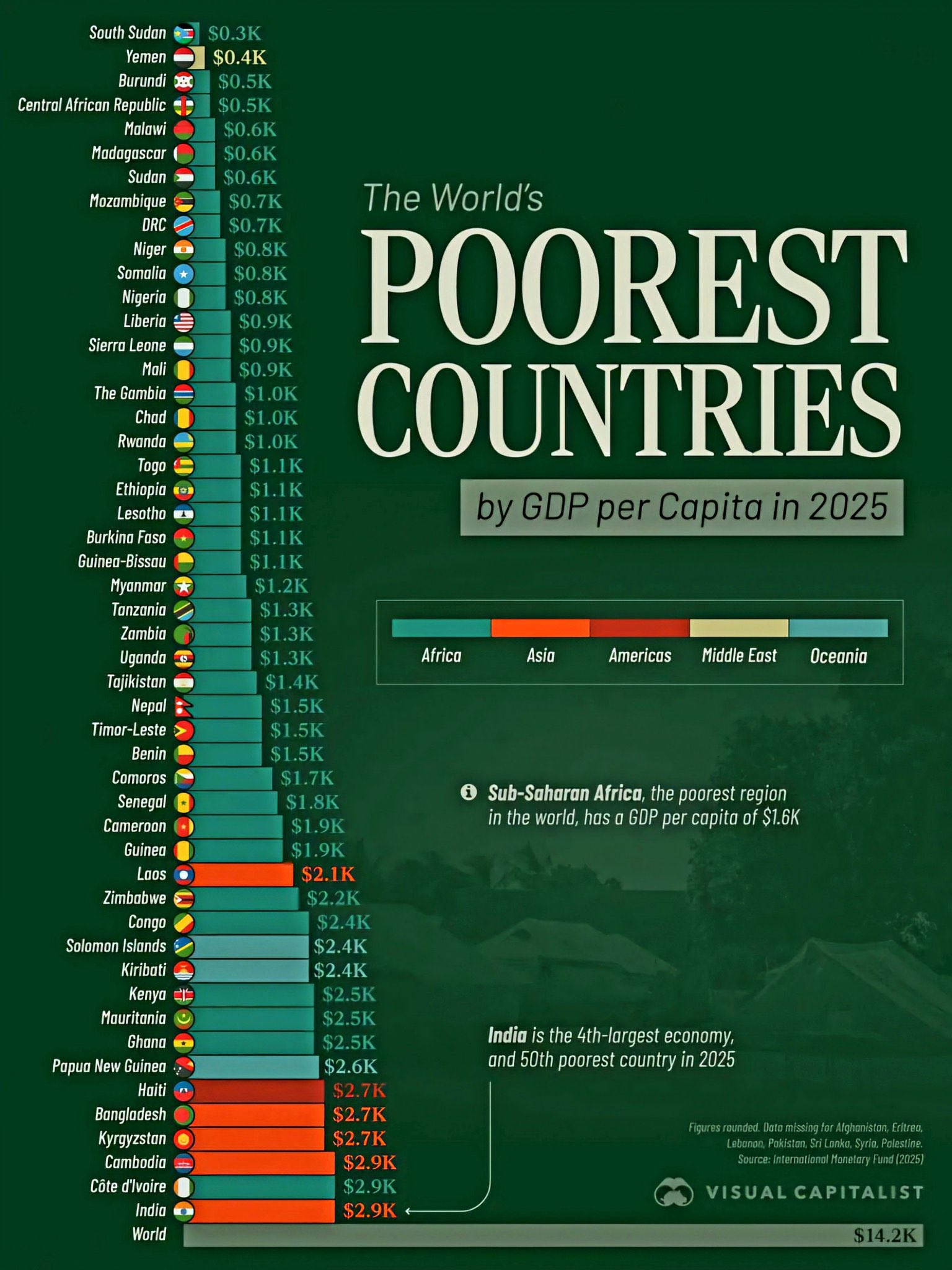
Source: Visual Capitalist — The world’s 50 poorest countries by GDP per capita in 2025, according to IMF data. Not a single former Spanish colony is included.
For the Spanish Monarchy, the inhabitants of the Americas, the Philippines, and other territories were not merely resources to be exploited: they were subjects of the king, and therefore part of the same political body as those born in Castile or Aragon. This vision, enshrined in laws and royal decrees from the 16th century onwards, meant that the Crown assumed responsibilities towards them.
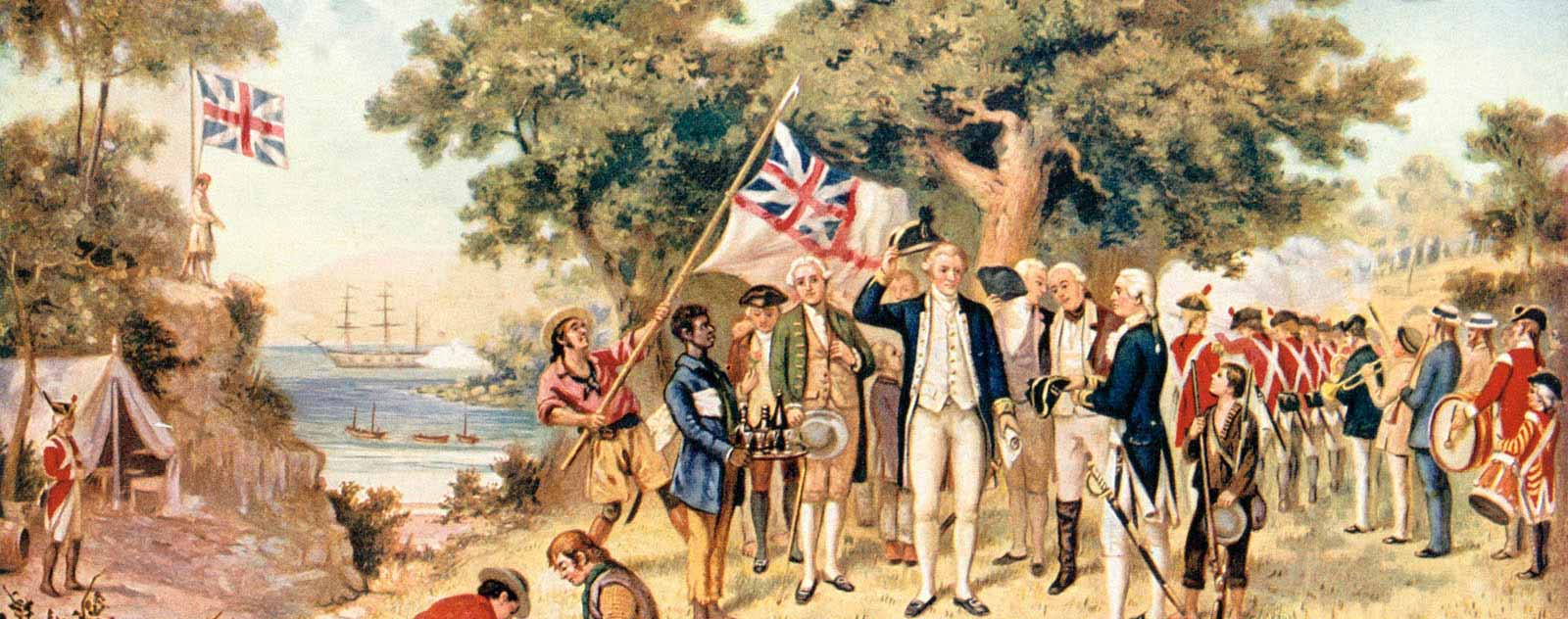
By contrast, predatory empires (British, Belgian, Dutch, in many of their domains) treated the local population as expendable labor. When it was depleted or wiped out by harsh conditions, it was replaced with enslaved labor imported from other continents. They were not citizens, but “natives” subject to a separate legal code, with no representation and no political rights in the metropole. Infrastructure was limited to what was necessary to extract raw materials and ship them to Europe.
The result was that, upon independence, former Spanish provinces inherited urban networks, ports, educational systems, and their own legal frameworks; whereas many former colonies of other empires started practically from scratch.
The Spanish Case
The Spanish Monarchy integrated its overseas territories as kingdoms and provinces, with their own institutions: viceroys, audiencias (high courts), and cabildos (municipal councils). Between the 16th and 19th centuries:
- Cities such as Mexico City, Lima, Bogotá, and Manila were founded.
- Universities were created (Santo Tomás in Manila; San Marcos in Lima; Mexico City; Córdoba).
- An extensive network of hospitals was created, providing access to health care for a broad spectrum of the population.
- A complete network of royal roads provided internal connections.
- Castilian unified huge administrative blocks.
- A legal system considered them subjects, with rights before the Crown.
A unique feature in colonial history is that the conquest itself was paused to publicly debate its legitimacy and the treatment of Indigenous peoples. Between 1550 and 1551, at the Valladolid Debate, figures such as friar Bartolomé de las Casas and Juan Ginés de Sepúlveda argued before jurists and theologians whether it was moral and legal to subjugate Indigenous peoples.

This debate did not arise out of nowhere: it belongs to the tradition of the School of Salamanca (Francisco de Vitoria, Domingo de Soto, Martín de Azpilcueta…), which laid the foundations of modern international law and defended principles such as:
- The intrinsic dignity of all peoples.
- The natural rights and original sovereignty of Indigenous communities.
- Moral and legal limits to war and colonization.
Although the conclusions of Valladolid were not always applied in practice, the episode and its intellectual framework reveal an empire that, at least on the legal and moral plane, set limits and recognized rights for its new subjects —something unthinkable in the predatory colonial models of the UK, Belgium, or the Netherlands.
This was not merely theory: distinguished foreign travelers saw it in practice. Alexander von Humboldt, upon visiting Mexico City at the beginning of the 19th century, wrote:
“No city of the new continent, without even excepting those of the United States, can display such great and solid scientific establishments as the capital of Mexico. I shall content myself here with naming the School of Mines, directed by the learned Elhuyar… the Botanic Garden; and the Academy of Painting and Sculpture.”
He described Havana as:
“Of all these great cities the Havannah bears the greatest resemblance to those of Europe in customs, refinements of luxury, and the tone of society.”
These observations show that the capitals of the Hispanic world were not mere administrative or military outposts, but urban centers comparable —and in some cases superior— to many European cities of their time. This urban, educational, and cultural network was no accident: it was the direct consequence of an imperial model that saw its overseas territories as an integral extension of the nation itself.
This framework meant that, upon independence, the new states did not start from zero, but with a solid institutional, urban, and cultural foundation.
The Contrast with Other Colonial Models
IMF data for 2025 shows a striking pattern: none of the world’s 50 poorest countries today were former Spanish provinces. By contrast, the vast majority were once under British, French, Belgian, or Portuguese rule.
This difference is not a mere geographical accident or “historical luck.” It stems from very different colonial models: while the Hispanic model integrated territories into an urban, institutional, and cultural network that allowed a degree of cohesion and internal development, other European empires applied systems oriented almost exclusively toward resource extraction, with little or no local reinvestment.
| Power | Number of former colonies in the top 50 poorest group |
| United Kingdom | 18 |
| France | 12 |
| Portugal | 8 |
| Belgium | 3 |
| Spain | 0 |
The result, visible more than a century after independence, is that former Spanish colonies generally have more diversified economies and inherited infrastructure that, despite political crises or internal inequalities, enabled them to avoid falling into extreme poverty. By contrast, many ex-British, French, Portuguese, or Belgian colonies inherited fragile structures dependent on monocultures or the export of raw materials without added value.
Current figures do not explain every historical nuance, but they do confirm a trend: the Hispanic model left behind an institutional and urban base that allowed its former territories to avoid the extreme poverty that characterizes much of the legacy of other European empires.
In the following sections, we will examine concrete cases —in the Americas, Africa, and Asia— that show, almost experimentally, how two territories with similar natural conditions can follow radically different economic and social trajectories depending on the colonial model that shaped them.
Contrasts Within the Same Island
A paradigmatic case of different colonial models can be found on the island of Hispaniola, shared by Haiti and the Dominican Republic.
- Same geography, climate, and natural resources.
- Two radically different colonial legacies.
Haiti was the richest French Caribbean colony at the end of the 18th century, sustained almost exclusively by the monoculture of sugar, coffee, and indigo, worked by a population of enslaved Africans. The system was intensive, extractive, and without reinvestment in local infrastructure or population development. Independence came in 1804, after a devastating war that destroyed plantations, cities, and much of the population. With no economic diversification or solid institutional framework, Haiti became trapped in chronic poverty, worsened by the indemnity France forced upon it in 1825 in exchange for recognition of independence. Today it consistently ranks among the poorest countries in the world.
The Dominican Republic, in contrast, inherited from the Spanish period a structure less dependent on monoculture, with established cities, ports, roads, and a mestizo population sharing common cultural and linguistic ties. Although its republican history has included wars, foreign occupations, dictatorships, and crises, it started from a more diversified and resilient institutional base. Today, its GDP per capita is several times higher than Haiti’s, and its economy relies on varied sectors such as tourism, services, and light industry.
This contrast, within the same island and under identical natural conditions, is an almost experimental illustration of how the Spanish-rooted colonial model —with urban, legal, and cultural integration— generated human and material capital that allowed sustained development, even with setbacks, versus the purely extractive and predatory French model, which left a structural legacy of fragility and dependence.
African Examples
Africa offers equally telling cases of what predatory empires leave behind when their sole objective is the extraction of wealth for the metropole.
Congo (Belgium)
At the end of the 19th century, the Congo Free State was administered as the personal possession of King Leopold II. The goal was the intensive exploitation of rubber and ivory, with a system of forced labor that caused millions of deaths and mass mutilations. No urban network or educational system for the local population was built; infrastructure existed solely to extract resources to the nearest port. When Congo gained independence in 1960, it lacked a modern administrative system, and its first generation of university graduates numbered less than one hundred. Today it remains among the poorest countries in the world.
Mozambique (Portugal)
Portuguese colonization in Mozambique kept an economic model centered on the export of raw materials (cotton, sugar, minerals), with minimal investment in education and infrastructure for the local population. Illiteracy exceeded 90% at the time of independence (1975), and cities were concentrated along the coast without integration with the interior. Decades later, Mozambique remains among the lowest GDP per capita countries on the planet.
Sierra Leone (United Kingdom)
Founded as a colony for the settlement of freed slaves, its development was marked by the exploitation of minerals, especially diamonds, under a system that mainly benefited British companies and associated local elites. The lack of economic diversification and solid infrastructure led to political instability and civil wars. Today, its GDP per capita is among the lowest in West Africa.
Equatorial Guinea (Spain)
Independent since 1968, it inherited from Spain a planned capital (Malabo), a basic network of schools and hospitals, and a literacy rate far higher than its neighbors. Its subsequent political history has been marked by personalist dictatorship, but even so, the discovery and exploitation of oil has made it one of Africa’s highest GDP per capita countries. The contrast with Congo, Mozambique, or Sierra Leone shows that even with severe governance issues, Spain’s starting point was more solid than the legacy of other European empires.
Gabon (France)
A French colony until 1960, Gabon is another example of a small African country rich in oil. However, exploitation followed the French “enclave economy” model: extraction for export, with profits concentrated in foreign companies and a local political elite. The result is a relatively high nominal GDP per capita, but with a poorly diversified economy, heavy dependence on crude oil, and extreme social inequality.
Asia and the Pacific
Philippines (Spain)
Under Spanish administration for more than three centuries, the Philippines developed an articulated urban network (Manila, Cebu, Iloilo, Vigan…), strategic ports for trans-Pacific trade, universities such as Santo Tomás (founded in 1611), and a common language that facilitated administration and social cohesion. The educational and health systems, though limited by modern standards, were relatively widespread for the era.
After 1898, with sovereignty transferred to the United States, several social and economic indicators declined, alongside an “Americanization” process that displaced Spanish as a language of culture. The Japanese occupation during World War II and subsequent political turmoil worsened economic fragility.
Timor-Leste (Portugal)
Under Portuguese rule until 1975, Timor-Leste received minimal investment in education, health, and infrastructure. The colonial economy relied on coffee and sandalwood plantations, without diversification. After independence and a long conflict with Indonesia, the country was left devastated. Today, despite having energy resources (oil and gas), it remains one of the poorest states in Southeast Asia, with a poorly diversified economy and heavy dependence on international aid.
These examples show that in Asia and the Pacific, Spanish heritage created territories with a more solid institutional and urban foundation, while other colonial models left far weaker structures, severely limiting their later development.
Conclusion
The Spanish Empire had flaws, conflicts, and hierarchies, but it followed a generative model: it integrated territories, built cities, created institutions, and sought social cohesion. Other empires —by design— were predatory: they exploited resources and people without laying the groundwork for sustainable development.
The results are clear more than a century later:
- No former Spanish province appears among the world’s 50 poorest countries.
- Many former British, French, Portuguese, and Belgian colonies remain trapped in extreme poverty, with fragile economic structures and high external dependence.
The oft-repeated phrase “if only the British had colonized us” ignores historical and current reality. IMF data shows that, had that been the case, many Hispanic American nations could today be trapped in the same cycle of extreme poverty that marks much of the British, French, Portuguese, or Belgian colonial legacy.
Far from being a burden, the institutional, urban, and cultural heritage of the Hispanic world gave our countries a much stronger starting point. The problems they face today stem from internal dynamics and later circumstances —not from any supposed inferiority of the Spanish legacy.
Sources:
- International Monetary Fund (IMF). World Economic Outlook Database, April 2025.
- Visual Capitalist. The World’s Poorest Countries by GDP per Capita in 2025.
Share this article
On this day
- 1690 The excellent Baroque painter Juan de Valdés Leal, nemesis of Murillo and famous for his "Vanitas" in the Hospital de la Caridad, dies in Sevilla.
- 1940 At dawn, Lluís Company y Jover, President of the Generalitat de Catalunya, is shot by a picket of soldiers at Montjuic Castle for the crime of military rebellion.
History of Spain