

July 21, 2025
Source: Web Hispania
Over the past few years one figure has circulated insistently: “22 percent of all enslaved Africans arrived in Spanish territories.” The statistic is correct in absolute terms, yet when used in isolation it sustains a de-contextualised narrative that portrays the Spanish Empire as the chief culprit of the Atlantic slave trade and, by extension, of the modern slave system. Only when we analyse that number in proportion to territory, population, chronology and the legislation of each power do we discover a far more complex reality.
This essay dismantles that simplification. We compare the Spanish model with the British—the benchmark in Anglophone historiography—and, in passing, with the Portuguese, French and Dutch empires. We will see that Castile was the first crown to ban indigenous slavery, that the bulk of plantation monoculture was concentrated outside the Hispanic viceroyalties, and that miscegenation, social mobility and manumission took on unique characteristics in the Iberian world.
The so-called Black Legend—a storyline that magnifies Spanish excesses while silencing or minimising those of other powers—was born in sixteenth-century Protestant Europe. Today recycled versions resurface on social media and even in academic forums. This text offers three basic tools:
- Quantitative context (territorial, demographic and chronological) that relativises the famous 22 %.
- Legal and moral framework: from the Laws of Burgos (1512) to the Valladolid debate (1550) and the School of Salamanca.
- Empirical cases of integration and upward mobility that shatter the idea of an impermeable racial hierarchy in the Hispanic Monarchy.
The aim is not to absolve—abuses certainly occurred—but to compare with data and nuance. It is also worth remembering that the Hispanic Monarchy was the only early-modern power to articulate a state welfare policy for all its subjects—peninsular, indigenous and even enslaved Africans—through royal hospitals, colleges, reductions, black confraternities and communal savings banks unmatched by other European empires. Only then can we properly assess each empire’s place in the greatest forced migration in history.
Encomienda vs Slavery
Encomienda is not identical to slavery. The Crown conceived it as a feudal guardianship: the encomendero received indigenous tribute and labour in exchange for protection and evangelisation. It stemmed from medieval Iberian practice, not from the sale of human beings as chattels.
| Feature | Encomienda (Spanish) | Racialised chattel slavery (Anglo-French-Portuguese) |
| Legal basis | Revocable royal concession | Perpetual private property |
| Worker’s status | Free vassal owing tribute | Moveable good with no legal personhood |
| Heritability | Not inheritable (unless re-granted) | Fully inheritable |
| Master’s duties | Sustain, protect, evangelise | Maximise labour; no moral duties |
| Manumission | Not applicable—the Indian is already a subject | Rare, at own |
| Legal foundations, status of the labourer, inheritance rules, obligations of the master and possibilities of manumission highlight how the encomienda—though harsh—was juridically distinct from perpetual racial slavery. | ||
Limiting legislation
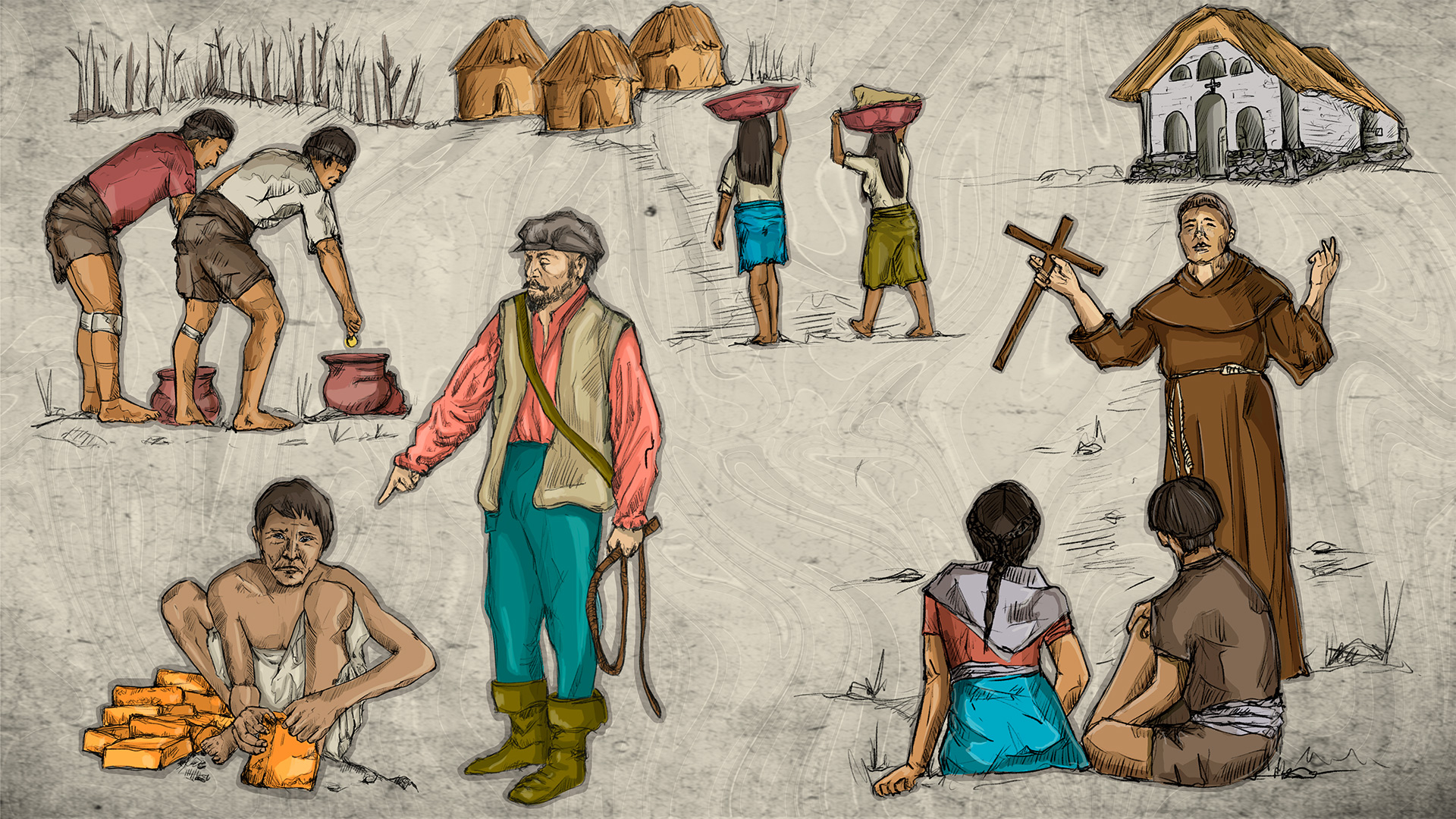
Indigenous workers under an encomendero (16th-century illustration).
- Laws of Burgos (1512): first code regulating indigenous labour—wages, work-day limits, catechesis.
- New Laws (1542): proclaim Indians “free vassals,” prohibit new encomiendas and order existing grants to lapse at the holder’s death.
- Recopilación de Indias (1680): reconfirms the ban on enslaving natives except for the ever-shrinking category of “just war.”
- Welfare infrastructure: royal hospitals (e.g., San Andrés, Lima), indigenous colleges (Tlatelolco) and communal banks that offered relief in sickness, widowhood and crop failure.
Moral debate in Castile
- School of Salamanca: Vitoria, Soto and others argued that natives possessed reason and dominion; enslaving them was sinful.
- Valladolid Controversy (1550–1551): Las Casas vs Sepúlveda. Practical outcome: indigenous humanity reaffirmed; enslavement delegitimised.
Abuses and oversight
Abuses occurred, but the Crown deployed visitadores and residencia trials; fines, exile and even executions of abusive encomenderos are documented.
Comparison with the British model
- English (and later British) colonies had no similar mechanism; Indians were foreigners or “savages,” to be displaced or eradicated.
- British America codified hereditary racial slavery (Virginia 1661) without an equivalent moral debate or legal curb.
Encomienda was harsh yet juridically distinct from chattel slavery. From the outset the Hispanic Monarchy legislated to limit and ultimately dismantle the institution—an ethical reflection absent at the birth of the Anglophone model.
Who Were the “Negroes” — and Why They Were Not the Indigenous
In Hispanic documentation from the sixteenth to the nineteenth century, the term “negros” almost always refers to sub-Saharan Africans—free or enslaved—brought in under the Asiento de Negros. It never designates American Indians, who in royal legislation appear explicitly as “indios” or “naturales” and are therefore full-fledged royal subjects.
Early ban on indigenous slavery
As early as 1500, a decree by Queen Isabella declared it illegal to capture and sell Indians except in cases of “just war”—a category subject to royal oversight and soon virtually abolished. The Laws of Burgos (1512) and the New Laws (1542) reinforced the ban and turned the natives into free subjects protected by the Crown. Hence the indigenous became taxpayers, not merchandise, and the Hispanic Monarchy had to look for alternative labour when encomienda proved insufficient.
Demographic, theological and economic reasons
- Demography: epidemic catastrophe—smallpox, measles, typhus—decimated populations in the Antilles and first-contact areas. The Crown needed to keep production (sugar, gold, pearls) going without violating its own ban on Indian slavery.
- Theology: the School of Salamanca argued that Indians possessed reason and natural dominion; enslaving them would be sin and tyranny. The same judgement was not extended to Africans, regarded—by the mentality of the day—as “just captives” taken in African wars and therefore legitimate objects of purchase.
- Economics: early mines and estates required disciplined labour physically resistant to tropical climates. Africans, accustomed to intensive regimes and partly immune to malaria, looked attractive to entrepreneurs and local officials.
The Asiento system
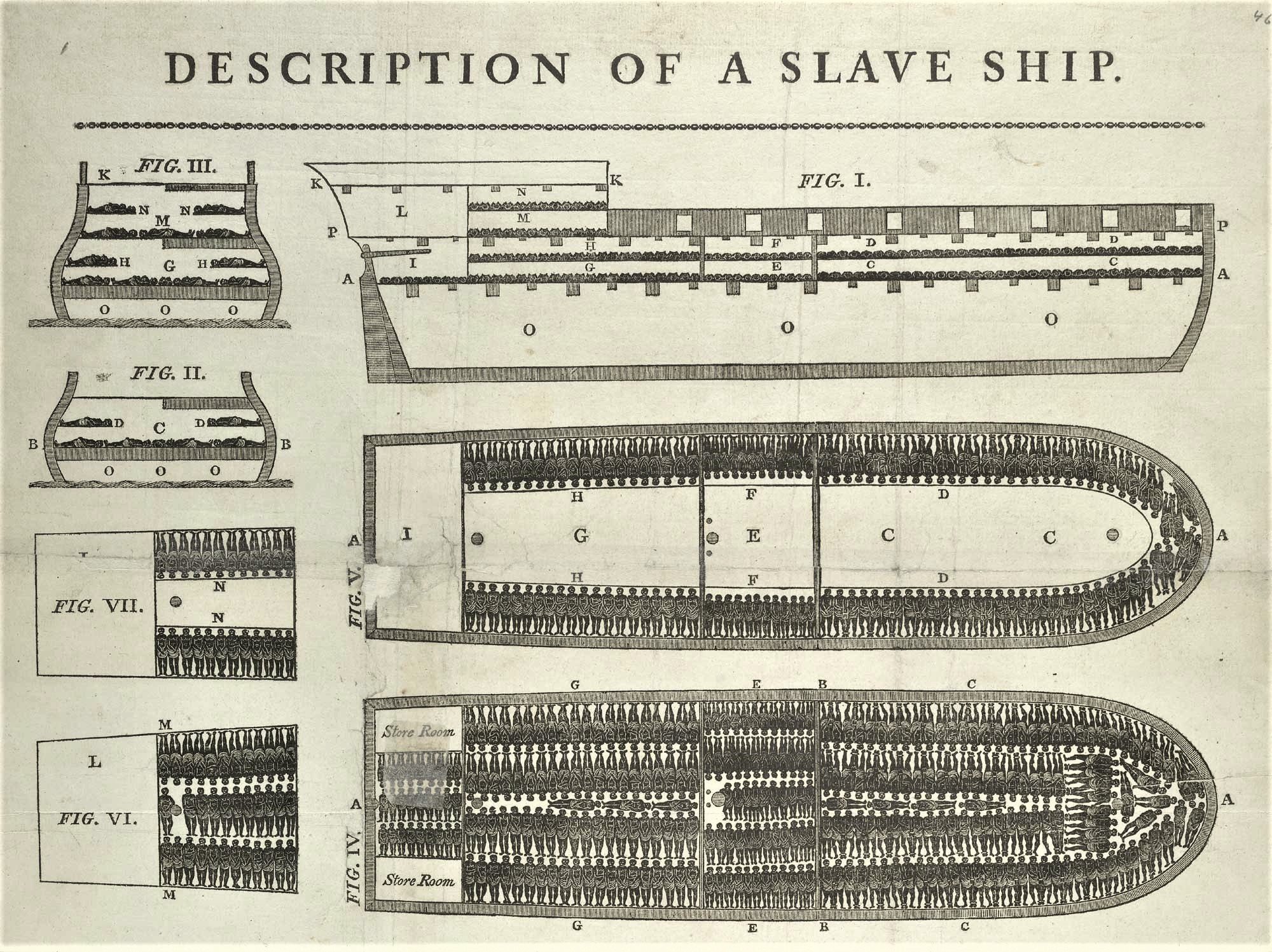
Brookes’ slave-ship diagram (1789), abolitionist print.
Unlike Portugal, England or France, Spain never created a large slaving fleet of its own. Instead, the Crown granted contracts (asientos) to merchants—almost always foreigners—who pledged to deliver a yearly quota of slaves to American ports (Cartagena, Veracruz, Buenos Aires, Havana). From 1518 to 1791 the asiento passed through Portuguese, French, Dutch, Genoese and finally British hands (1713 asiento in the Treaty of Utrecht). In practice, Spain outsourced the “dirty business” to rival powers and collected import duties.
Legal protection inside the empire
Once on Hispanic soil, an African—even if enslaved—entered the Catholic community: baptism, the right to marry, to join a confraternity and, in some cases, to coartación (installment purchase of freedom). Courts could hear complaints of mistreatment and grant manumission. Cofradías of Blacks raised funds to redeem slaves, bury the dead and support widows and orphans. This social network, backed by religious orders and local authorities, added a layer of state-and-church welfare unknown in British or French colonies.
Demographic and cultural impact
By 1800 the Afro-descendant population in Spanish territories was sizable—especially in Cuba, Puerto Rico, Veracruz and the Caribbean coast of New Granada—yet never outnumbered the indigenous or mestizo population empire-wide, unlike British sugar islands where slaves made up over 80 % of inhabitants. African culture blended into liturgy, music (son, candombe), cuisine and American Spanish.
“Negroes” in Spanish America were Africans introduced by mostly foreign agents under royal contract. Their presence stemmed from the legal protection of the Indian and economic need, not from a systematic plan to enslave natives. The Hispanic legal framework, with all its limits, offered channels of defence and advancement that contrasted with the racial rigidity of the British world.
Social Mobility in the Hispanic World
The Hispanic Monarchy created avenues of advancement for Indigenous, Afro-descendant and mestizo people that—while they never abolished discrimination—offered opportunities unthinkable in other colonial empires.
Iconic cases of upward promotion
- Inca Garcilaso de la Vega (Cuzco 1539 – Córdoba 1616): son of an Inca princess and a Spanish captain; celebrated chronicler, knight of Santiago and royal official.
- Juan Latino (?? – Granada 1597): born enslaved of African origin in his master’s household, educated alongside the heir, gained freedom and became professor of grammar at the University of Granada—the first Black university professor in early-modern Europe.
- Francisco Javier Girón y Ezpeleta (Pamplona 1803 – Madrid 1869): 2nd Duke of Ahumada, founder and first director-general of the Guardia Civil (1844). By maternal line he was a direct descendant of Moctezuma II, proof that Indigenous lineages could enter the highest ranks of Spanish nobility.
- … and many more.
Access to offices and trades
- Indigenous and mestizos could serve as caciques, town councillors, court procurators and even junior army officers.
- Free Afro-descendants enlisted in pardo and moreno militias and practised skilled arts and trades (silversmithing, music, printing).
Support and welfare networks
- Cofradías of Blacks, mulattoes and Indigenous people acted as religious mutual-aid societies: they paid funeral costs, provided dowries for orphaned girls and financed manumissions.
- Hospices, hospitals and colleges sponsored by the Crown and religious orders—e.g., the College of San Francisco for Natives in Mexico—offered universal education and medical care, resources absent in British colonies.
The Spanish legal structure acknowledged personhood before race. Real hierarchies persisted, yet formal pathways of social mobility—ecclesiastical, military, academic—existed, in sharp contrast to the racial rigidity of British and French systems, where law barred Indigenous and Black people from citizenship and public office.
The 22 Percent in Context
The oft-quoted “22 percent” comes from the academic database Slave Voyages and David Eltis and David Richardson’s Atlas of the Transatlantic Slave Trade. According to those sources, of the roughly 12.5 million Africans loaded onto ships bound for the Americas between 1501 and 1867, about 1.8–2.2 million (depending on whether coast-to-coast re-exports are counted) disembarked in ports under Spanish sovereignty: Cartagena de Indias, Veracruz, Havana, Santo Domingo, Buenos Aires or Montevideo.
| Imperial destination | Africans landed | Share of total |
| Brazil (Portugal) | 4,850,000 | 38.5% |
| British Caribbean + Thirteen Colonies + Belize | 2,300,000 | 18.4% |
| France (Saint-Domingue, Guadeloupe, Martinique, Louisiana) | 1,700,000 | 13.6% |
| Spain (Spanish America + Philippines) | 2,000,000 | 22% |
| Netherlands (Suriname, Curaçao, Aruba) | 160,000 | 2% |
| Denmark (Danish Virgin Islands) | 24,000 | 0.3% |
| TOTAL | 12,500,000 | 100% |
| Estimated numbers landed in each empire and their percentage of the entire trans-Atlantic trade. Source: Slave Voyages database; Eltis & Richardson (2010). | ||
At first glance Spain’s percentage looks high, yet the raw figure hides three crucial variables:
- Territorial span — Spain controlled almost 60 percent of the American landmass. Brazil, Colombia, Peru and Mexico together dwarf Barbados or Haiti many times over. Per square kilometre, Spain imported far fewer slaves than any other power (see § 5).
- Demographic weight — By the late eighteenth century Spanish domains had over 18 million inhabitants (mostly Indigenous and mestizo). Africans made up under 12 percent of that total, compared with Saint-Domingue (France), where slaves were 88 percent of the population, or Jamaica (Britain) with over 90 percent.
- Chronology — Spain’s participation stretches across three centuries (c. 1520-1820). Britain and France concentrated their peaks between 1700 and 1807, the sugar- and cotton-boom years. At their annual maximum the British landed up to 50,000 captives; Spain rarely exceeded 10,000.
How does that 22 percent build up?
- Sixteenth century — Portuguese asiento holders delivered modest contingents to the Antilles, New Spain and the Isthmus: about 200,000 Africans in one hundred years (≈ 15 percent of the century’s total).
- Seventeenth century — Silver mining at Potosí relied on Indigenous labour; the trade shifted toward the Spanish Caribbean and New Granada. Spain received 310,000 slaves (≈ 26 percent of the century).
- Eighteenth century — The Cuban sugar boom and the asiento granted to the South Sea Company (1713-1740) raised arrivals to 1.4 million (≈ 25 percent of eighteenth-century traffic): the decade when the global percentage spikes.
- Nineteenth century — The trade was gradually outlawed (British Act 1807; Anglo-Spanish treaties 1817 and 1835) yet persisted in Cuba and Puerto Rico until 1867. A further 80,000 captives (≈ 10 percent of the century) pushed the cumulative Spanish figure to the famous 22 percent.
What the percentage does not say
- Spain was a net importer, not the dominant trafficker: almost every slaver that touched Hispanic ports flew Portuguese, British or French colours. The Crown collected duties but outsourced the commerce.
- Internal distribution: more than 60 percent of Africans landed in Spanish domains went to Cuba and Santo Domingo; the rest scattered among urban and mining contexts rather than vast plantations.
- Legal integration: once on Hispanic soil, slaves—though bound—gained access, however limited, to sacraments, legal recourse and possibilities of manumission (see § 8).
The 22 percent is useful to gauge the African presence in the Hispanic world, but without factoring territory, population and temporal rhythms it fuels the fallacy of a “super-slaveholding Spain.” In truth, Spanish slave density was several times lower than the British, French or Portuguese equivalents.
Proportional Comparisons
After establishing the 22 percent in absolute terms, we must relativise it to gauge the real slave-system density in each empire. We do so with two ratios:
- Slaves-to-territory index
- Slaves-to-total-population index
Both calculations use Spain as the baseline (= 1). The figures are illustrated in the two accompanying charts.
Territorial intensity
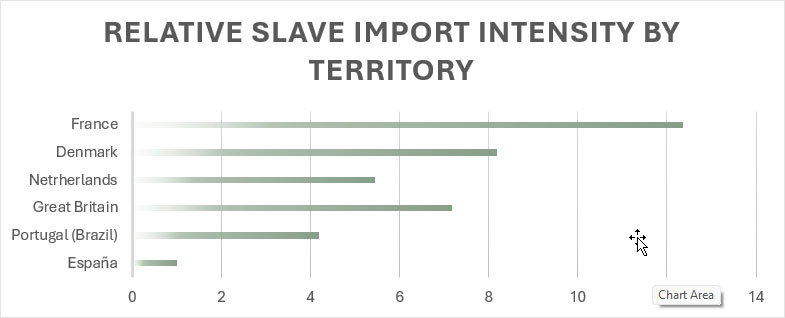
Relative Slave-Import Intensity by Territory (Spain = 1).
| Power | Share of American land (%) | Share of slave trade (%) | Relative index (Spain = 1) |
| Spain | ~60% | 22% | 1 |
| Portugal (Brazil) | 25% | 38.5% | 4.2 |
| United Kingdom | 7% | 18.4% | 7.17 |
| France | 3% | 13.6% | 12.36 |
| Netherlands | <1% | 2% | 5.45 |
| Denmark | 0.1% | 0.3% | 8.18 |
| Ratio of Africans landed per square kilometre of American territory controlled by each power. Higher values indicate a denser plantation system. | |||
France had to import over twelve times the slave density per km² that Spain did; Britain seven times. Even Portugal—with a large though smaller territory—quadrupled the Spanish intensity. The plantation economy was geometrically denser outside the Spanish sphere.
Demographic load
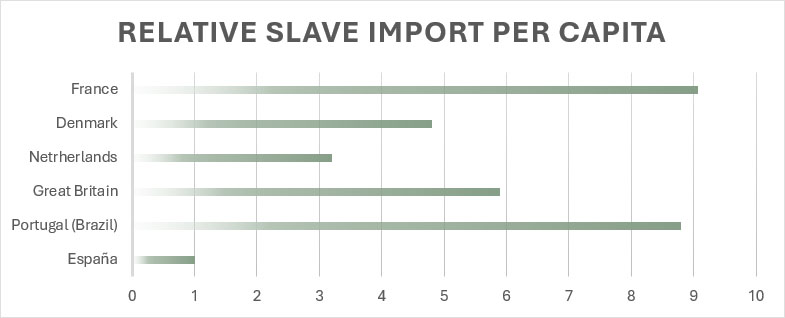
Relative Slave-Import Per Capita (Spain = 1).
| Power | Population c. 1780 (millions) | Historical slave imports | Relative index (Spain = 1) |
| Spain | 1.2 | 22% | 1 |
| Portugal (Brazil) | 3.5 | 3.1 mill | 8.8 |
| United Kingdom | 2.5 | 1.47 mill | 5.89 |
| France | 1.2 | 1.1 mill | 9.07 |
| Netherlands | 0.5 | 160,000 | 4.80 |
| Denmark | 0.05 | 24,000 | 3.20 |
| Historical imports per million colonial inhabitants around 1780, showing the demographic weight of slavery within each imperial society. | |||
With a population almost ten times smaller, France imported a similar number of slaves to Spain, meaning its society was nine times more saturated with captive labour. Brazil and the British Caribbean show similarly staggering ratios.
Social consequences
- Racial structure: Franco-British plantations reached ratios of eight slaves per white colonist, generating draconian black codes. In Spanish America the ratio rarely exceeded one slave for every five free inhabitants.
- Systemic violence: High slave densities drove periodic rebellions (Tacky’s Revolt, Jamaica 1760; Haiti 1791). Uprisings under Spanish rule were fewer and, when they arose (Coro 1795, Aponte 1812), mixed political motives with demands for citizenship.
- Mestizaje: Lower concentration allowed the group blending and mobility described in section 3—almost nonexistent in colonies with slave majorities.
The Time Dimension
The timeline of the trade reveals another distortion: Spain took part for three centuries at moderate volumes, whereas other powers concentrated the bulk of their traffic into short windows of peak profitability.
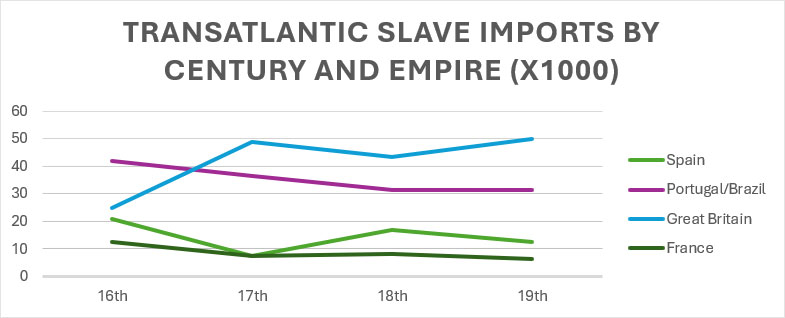
Transatlantic Slave Imports by Century and Empire (× 1 000).
Comparative chronology of annual peaks
| Period | Spain (annual max.) | Portugal/Brazil | Great Britain | France |
| 1550-1650 | 4,000 | 10,000 | — | — |
| 1700-1800 | 10,000 | 30,000 | 50,000 (1768) | 48,000 (1788) |
| 1800-1830 | 6,000 | 20,000 | Trade virtually illegal (banned 1807) | 5,000 (illegal) |
| Highest recorded yearly landings for Spain, Portugal/Brazil, Britain and France, underscoring the concentrated surges of the eighteenth century. | ||||
Between 1760 and 1790 Britain and France each exceeded Spain’s entire seventeenth-century import total in less than five years.
Abolition timelines
- United Kingdom: slave trade banned in 1807; slavery abolished 1833, though forced “apprenticeships” lingered until 1838.
- France: trade banned 1817, slavery reinstated by Napoleon (1802) and definitively abolished in 1848.
- Spain: trade declared illegal (1817 treaty with Britain, reinforced 1835); gradual emancipation in Puerto Rico (1873) and Cuba (1886).
- Portugal/Brazil: trade illegal in 1836 (Portugal) yet continued clandestinely until 1850; slavery abolished in Brazil, 1888.
Interpretation
- Britain’s early ban came after maximising its profits—a classic “cash-out while the coffers are full.”
- Spain, with lower annual volumes, took longer to shut the door because economic pressure fell on Cuba, whose sugar boom followed Haiti’s independence.
- Spain’s longer duration dilutes its average to roughly 6 percent of the decade-by-decade trade, versus Britain’s 30 percent at its 40-year peak.
Visualisation
The accompanying charts show:
- The cumulative curve, 1520–1886, with the steep British-French slope (1700-1807) versus Spain’s gentler rise.
- Abolition decrees overlaid, highlighting the gap between public morality and economic exhaustion.
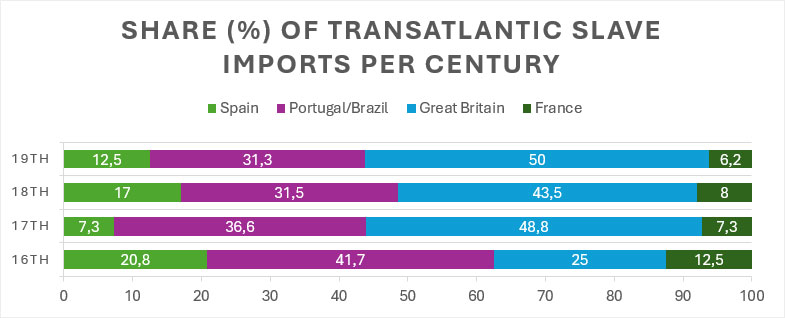
Share (%) of Transatlantic Slave Imports per Century.
When territory, population and tempo are factored in, Spain’s share of the trade is four to twelve times lower than its rivals’. The isolated “22 percent” is therefore an empirically distorted figure that only makes sense in multidimensional context.
Historical Continuity of Slavery
Slavery is as old as war and commerce. Greeks, Romans, Persians, Arabs and Africans all practised forms of bondage long before 1492. During the Middle Ages the Islamic world maintained trans-Saharan and Indian-Ocean slave routes, and on the Iberian Peninsula there were markets for white (Slavic), Berber and sub-Saharan captives.
The Atlantic shift
- In the early fifteenth century Portugal set up trading factories at Arguim, São Jorge da Mina and Luanda, linking coastal depots to African kingdoms such as Benin and Kongo. There it pioneered the model of large-scale traffic later copied by Castilians, Dutch, English and French.
- Spain entered the trade after 1492, but with a critical difference: the Crown conceived America as its own kingdoms, not as mere trading posts. That limited the establishment of massive plantations until the eighteenth century.
From the Mediterranean market to the Atlantic
Castilian law permitted slavery before the conquest but with restrictions: captives had to be “justly enslaved” (prisoners of war, Barbary corsairs, etc.). That doctrine was projected onto Africa: Portuguese merchants claimed that African kings sold prisoners taken in internal wars. The Crown accepted that rationale—grudgingly—and codified it in the earliest asientos.
Resistance, rebellion and moral change
- African uprisings in Santo Domingo (1522) and Veracruz (1609) exposed the instability of a system based solely on coercion.
- The Church, through Jesuits and Dominicans, denounced abuses and promoted coartación—self-purchase in instalments—unknown in the British or French Caribbean.
- From 1700 onward, the Spanish Enlightenment (Feijoo, Campomanes) and the Economic Societies of Friends of the Country advocated manumission and wages, foreshadowing nineteenth-century abolitionist reforms.
Slavery in the Spanish Empire belongs to a long historical continuum, yet it was subject to internal moral tension that ultimately limited its expansion compared with plantation models elsewhere.
Living Conditions and Comparative Treatment
Two economies, two realities
- British and French plantations: monocultures of sugar, coffee or cotton; sixteen-hour workdays; annual mortality close to 7 percent; constant replenishment directly from Africa.
- Spanish domains: a town-and-mine economy (Mexico, Peru) plus mixed-crop haciendas; lower mortality (≈ 3 percent) and far higher rates of miscegenation and manumission.
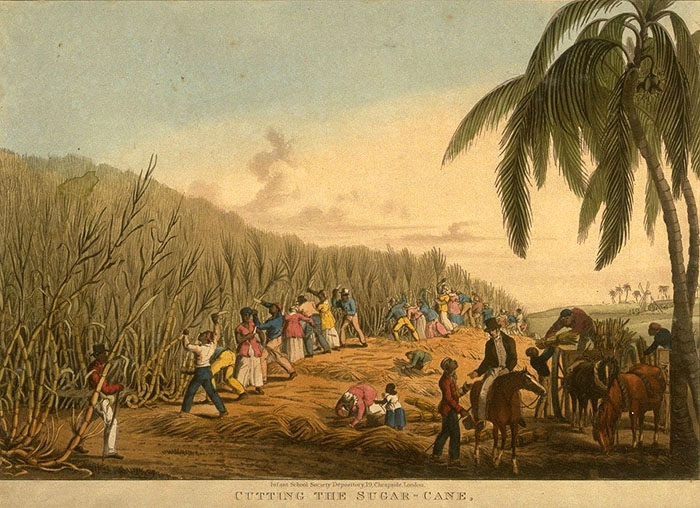
Cutting sugar-cane on a Caribbean plantation, late 18th c.
Protective legislation in practice
- The French Code Noir (1685) and the various British slave codes defined the slave as a “movable good.” Spain never adopted a similar code; instead it relied on general law and a “protective justice” doctrine: slaves could sue their masters for mistreatment before the Audiencia.
- Coartación: the right to buy one’s freedom in instalments, recognised by royal decrees of 1789 and widely practised in Cuba and Caracas.
- Baptism, marriage and sacraments conferred legal personality. A baptised slave could testify in court, inherit personal savings (peculio) and even purchase land.
Care infrastructure
- Hospital de San Lázaro (Havana), San Andrés (Lima) and the Royal Hospital for Natives (Mexico City) treated slaves, freedmen and Indigenous people free of charge.
- Cofradías de palo y nación: self-managed Black networks that paid funeral costs, guaranteed coartación loans and provided alms for the elderly or sick.
Rates of manumission and miscegenation
- In the Spanish Caribbean 20 percent of the Black population was free before 1800; in Jamaica the figure barely exceeded 5 percent.
- Interracial marriages, though monitored, were legal with ecclesiastical dispensation. The mulatto caste became a backbone of urban militias and crafts, whereas in British colonies the “one-drop rule” blocked any upward mobility.
Spanish slavery may have been harsh, yet its lower density, legal framework and welfare infrastructure made it less deadly and more permeable than the systems of its competitors.
Refuge in Spanish Territories
Fort Mose and the Spanish Asylum Policy
In 1738 Governor Manuel de Montiano founded Fort Mose, just north of St Augustine (Florida), as a garrison-town for fugitive slaves from the British colonies. In exchange for conversion to Catholicism and military service, the refugees received freedom, arms and land.
- Battle of 1740: the Black militia of Mose repelled a British assault—proof that the policy worked.
- A Royal Cedula of 1693 (Charles II) had already offered freedom and shelter to any slave who crossed the frontier into Spanish territory.
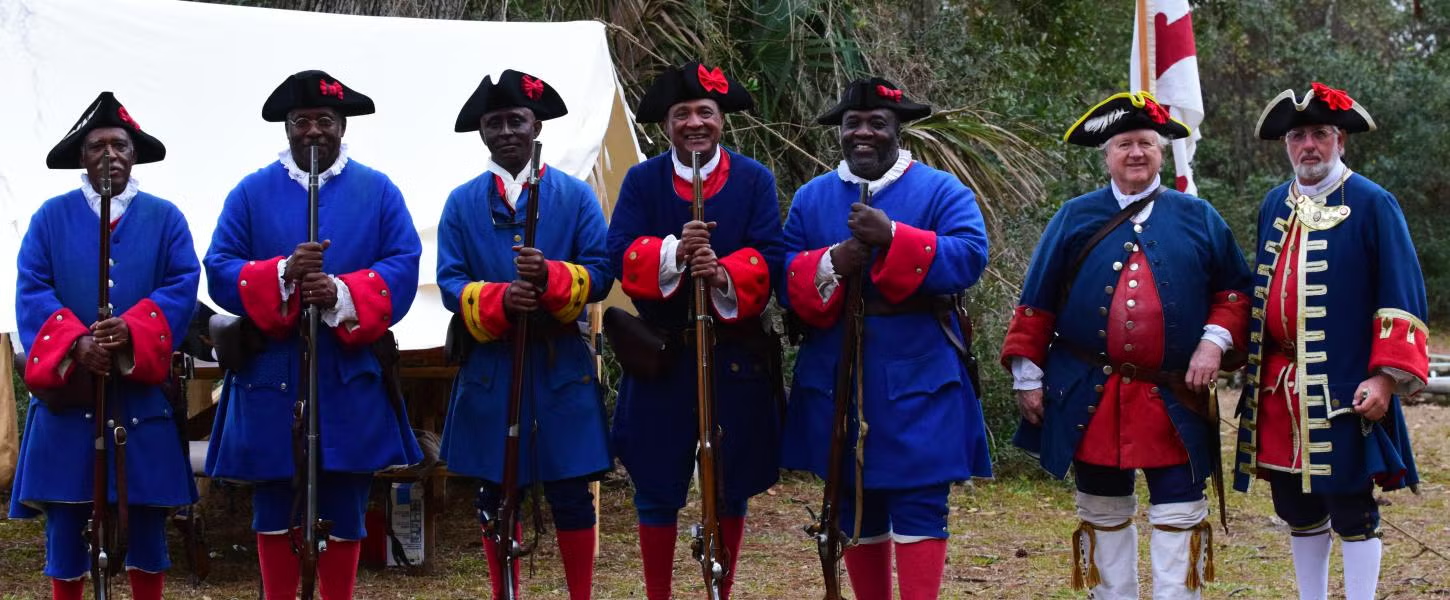
Re-enactors of the Black militia at Fort Mose, Spanish Florida.
Other escape corridors
- Spanish Louisiana (1763-1803) expanded coartación and recorded a sharp rise in free people of colour—up to 20 percent of New Orleans’s population.
- New Granada: maroon settlements such as San Basilio de Palenque (near Cartagena) were first tolerated, then recognised as free municipalities.
British reaction and mythology
The existence of free Black enclaves under Spanish rule was cited by English colonists as evidence of “popish intrigue.” Ironically, it shows that the first anti-slavery frontier in North America was established by the Spanish Crown.
The Spanish Empire not only offered legal paths to freedom, it also provided a geopolitical refuge for runaways from British plantations—an humanitarian dimension rarely acknowledged in Anglophone narratives.
Conclusion
The raw 22-percent figure shows only one facet of a multi-sided reality. Once territory, population, chronology and legal framework are added, we see a story that is far less Manichaean—and, above all, radically different from the version often promoted in Anglophone accounts.
- Relative dimension — Spain controlled most of the continent’s landmass yet moved several-fold fewer captives per square kilometre and per inhabitant than the Portuguese, British or French empires. Slave density was highest where European planters staked everything on monoculture: Haiti, Barbados, Jamaica, Brazil.
- State policy — From the Laws of Burgos (1512) to eighteenth-century coartación, the Hispanic Monarchy built a legal corpus that—gaps aside—recognised indigenous personhood and offered Africans avenues to freedom. No other empire legislated as early or as deeply to curb the trade and protect non-European subjects.
- Imperial welfare — Royal hospitals, native colleges, confraternities, communal banks, pardo militias… No other empire invested comparable resources in health, education and assistance infrastructure for subjects of every colour. In practice, a Hispanic slave could turn to courts and priests; the British or French planter recognised neither voice nor dignity.
- Mobility and mestizaje — Moctezuma’s descendants in Iberian nobility, Juan Latino in a Granada chair, or the freedmen of Fort Mose in Spanish uniform show that imperial society absorbed and promoted people of Indigenous and African descent. Mestizaje was not an exception but a defining trait.
- Chronology and profit — While Spain imported moderate contingents over three centuries, Britain and France packed their ships in barely forty years to feed a more lucrative, brutal plantation capitalism. Once the market was saturated they led abolition and cast themselves as moral beacons—conveniently overlooking the fortunes already banked.
- Refuge and resistance — The Spanish frontier offered legal asylum and arms to runaways from the Anglophone “free world.” The very existence of Fort Mose, recognised maroon towns and ecclesiastical manumissions demolishes the idea of a monolithically oppressive Spain.
Beyond the Black Legend
Comparison is inevitable; honest comparison is an intellectual duty. The Spanish Empire committed abuses, exploited resources and defended caste privileges. Yet it did not base its economy on Indigenous extermination or a massive, racially sealed slave plantation system. Equating its model with Britain’s, minus nuance, perpetuates the Black Legend and whitewashes other empires’ darker shadows.
The 22-percent distortion magnifies a single actor and distorts the rest in the mirror. Level the scale, and Hispanophobia loses ground; the Atlantic moral map shows shades of grey, not caricatures.
“History,” Cervantes said, “cannot bear witness to falsehood.” Let us then accept complexity: recognise the victims, understand the structures, and above all ensure the past is not weaponised to conceal present guilt.
Sources
Books and reference works
- Cañizares‑Esguerra, Jorge. 2001. How to Write the History of the New World: Histories, Epistemologies, and Identities in the Eighteenth‑Century Atlantic World. Stanford: Stanford University Press.
- Curtin, Philip D. 1969. The Atlantic Slave Trade: A Census. Madison: University of Wisconsin Press.
- Elliott, J. H. 2006. Empires of the Atlantic World: Britain and Spain in America 1492‑1830. New Haven: Yale University Press.
- Eltis, David, and David Richardson. 2010. Atlas of the Transatlantic Slave Trade. New Haven: Yale University Press.
- Hanke, Lewis. 1949. The Spanish Struggle for Justice in the Conquest of America. Philadelphia: University of Pennsylvania Press.
- Klein, Herbert S. 2010. African Slavery in Latin America and the Caribbean. 2.ª ed. Oxford: Oxford University Press.
- Pagden, Anthony. 1982. The Fall of Natural Man: The American Indian and the Origins of Comparative Ethnology. Cambridge: Cambridge University Press.
- Thornton, John. 1998. Africa and Africans in the Making of the Atlantic World, 1400‑1800. 2.ª ed. Cambridge: Cambridge University Press.
- Wright, Irene Aloha. 1916. Documents Concerning English Voyages to the Spanish Main, 1568‑1580. London: Hakluyt Society.
- Slave Voyages: The Trans‑Atlantic Slave Trade Database. 2024. https://www.slavevoyages.org/.
Articles and archival pieces
- Barcia, Manuel. 2014. “La coartación en la Cuba del siglo XVIII: dinámicas económicas y redes sociales.” Anuario de Estudios Americanos 71 (1): 59–86.
- Bennett, Herman L. 2012. “Palenques and Black Resistance in Colonial New Granada.” Journal of Colonial Latin American History 21 (2): 145–176.
- Childs, Matt D. 2000. “Self-Purchase and the Free Black Population of Late-Colonial Cuba.” Latin American Research Review 35 (3): 127–149.
- Echeverri, Marcela. 2016. “Liberty and Dignity in the Spanish Empire: Slaves, Racial Politics, and Abolition in the New Granada Militia.” Hispanic American Historical Review 96 (1): 1–34.
- González-Subías, José. 2009. “El Hospital de San Lázaro de La Habana y la asistencia a esclavos enfermos (1790-1840).” Dynamis 29: 113–138.
- Landers, Jane. 1990. “Free and Enslaved Black Militiamen in the Spanish Defense of Florida, 1683–1806.” The Florida Historical Quarterly 68 (3): 271–292.
- Landers, Jane. 1999. Fort Mose: Colonial America’s Black Fortress of Freedom. Gainesville: University Press of Florida.
- Martínez, María Elena. 2013. “Cofradías de negros y mulatos en la Nueva España: solidaridad y negociación social.” Estudios de Historia Novohispana 49: 5–37.
- O’Toole, Rachel Sarah. 2007. “Royal Audiencias and the Legal Voice of Enslaved Africans in Peru.” Slavery & Abolition 28 (3): 349–368.
- Recopilación de Leyes de los Reinos de las Indias. 1680. Libro VI, títulos 12–14: “De los esclavos e indios.” Facsimile PDF, Archivo General de Indias, Seville.
(The Slave Voyages database is added as a digital primary source and reference monographs are included for scholarly debate).
Share this article
On this day
- 1690 The excellent Baroque painter Juan de Valdés Leal, nemesis of Murillo and famous for his "Vanitas" in the Hospital de la Caridad, dies in Sevilla.
- 1940 At dawn, Lluís Company y Jover, President of the Generalitat de Catalunya, is shot by a picket of soldiers at Montjuic Castle for the crime of military rebellion.
History of Spain