

June 21, 2025
Source: Web Hispania
In the furnace of 19 July 1808, with Jaén’s dust swirling like gun-smoke and French drums rolling toward victory, Spain’s fate hung not on a general’s plan but on a sixty-five-year-old villager named Maria Bellido: she strode through musket fire with a clay pitcher, saw it blasted to shards, yet still cupped the last drops to General Reding’s lips—an un-heralded gesture of water and defiance that stiffened the Spanish line and helped turn Bailén into Napoleon’s first open-field defeat.
On the sun‑scorched fields of Jaén, 19 July 1808, General Teodoro Reding and the militia of Francisco Javier Castaños halted Napoleon’s imperial columns for the very first time. That day — the Battle of Bailén — has been chronicled a thousand times; yet the name Maria Paula Bellido Vallejo — nicknamed La Culiancha (“broad‑hipped”) — barely echoes beyond local memory. Standing with a clay water‑pitcher shattered by a French ball, this sixty‑five‑year‑old woman became a symbol of popular Hispanidad: not an aristocrat, not a professional soldier, but ordinary folk who, with faith and courage, carried the weight of war.
The press soon forgot her; liberal chroniclers dismissed her as legend. WebHispania rescues her as counterpoint to narratives that downplay Spain’s popular factor, reminding us that History is not written only by generals and kings but also by water‑bearers who cool the cannons and the soldiers’ spirits.
A Blistering Context: Summer 1808
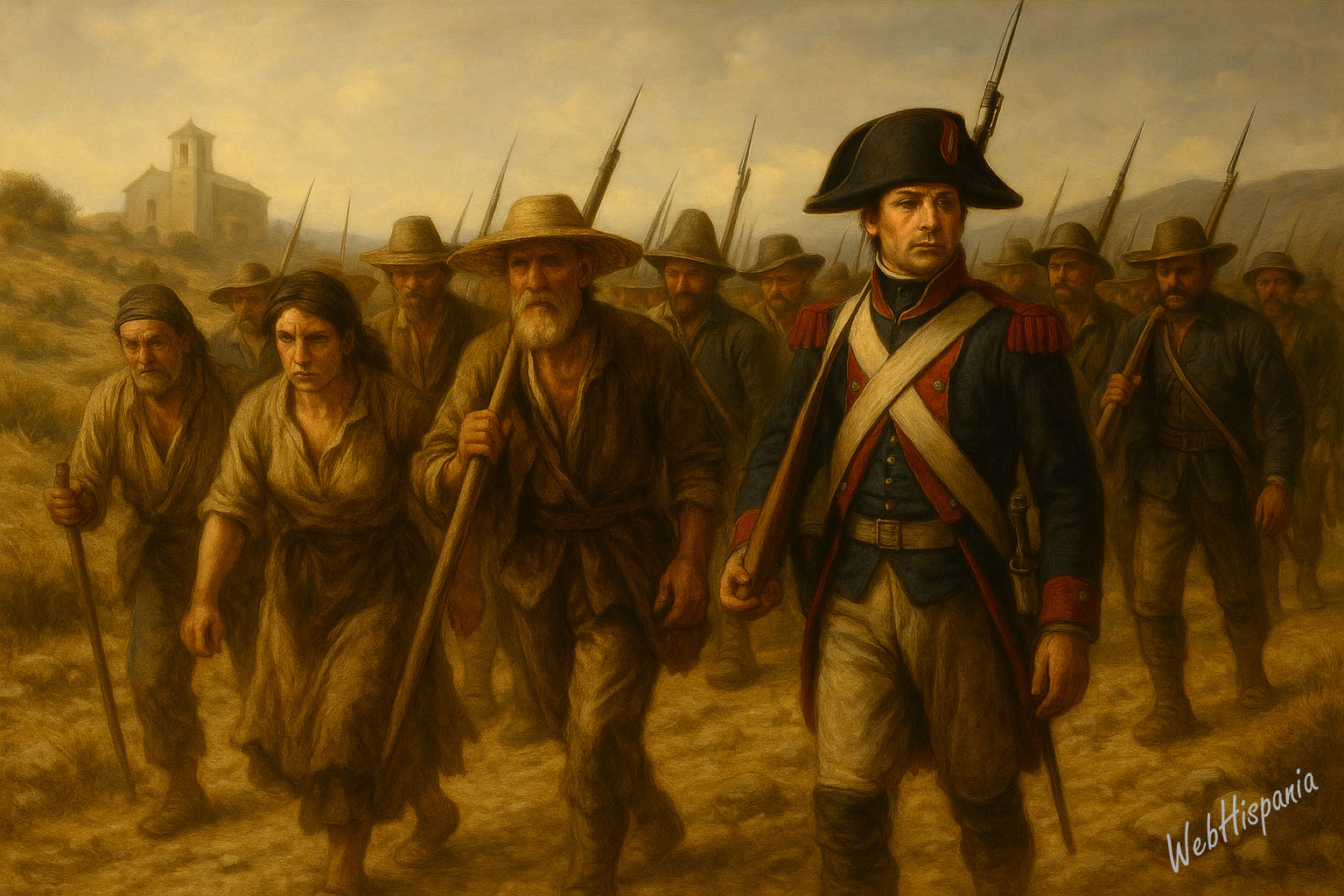
“No shade, no surrender.” Civilians and troops cross the furnace of Jaén en route to Bailén. (AI-generated)
After the 2 May uprising and Dupont’s first setbacks at Mengíbar and La Carolina, the French expected to crush Andalusian resistance with swift manoeuvres. Yet at dawn on the 19th the thermometer topped 42 °C. The treeless plain burned; dry wheat burned; Spaniards and Frenchmen alike burned. And all were thirsty.
Eyewitness Antonio José Carrero wrote: “Heat and thirst forced the troops to fall back… every enemy unit approaching the Rumblar was met with grapeshot” (Carrero 1815). Whoever controlled water would control the battle.
Bailén Mobilises: An Improvised Commissariat
With able‑bodied men enlisted or carrying stretchers, women and children formed human chains to haul water. Buckets, clay jugs and botijos left town full, returned empty, refilled at wells and norias, and set off again to the front. Among those women was Maria Bellido, born in Porcuna (1743) and married in Bailén to Luis Domingo Cobo.
La Culiancha was no nun‑soldier or noble Amazon; she simply embodied the strength and tenacity of Jaén’s countryside.
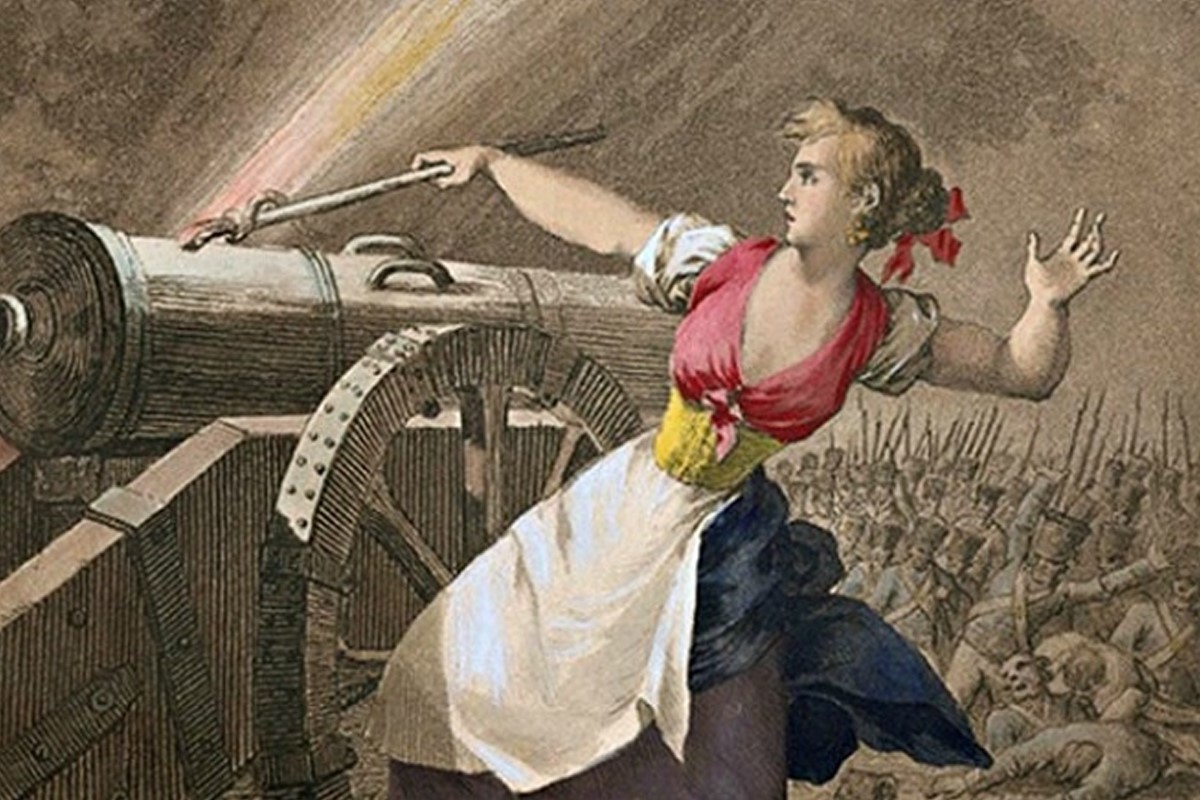

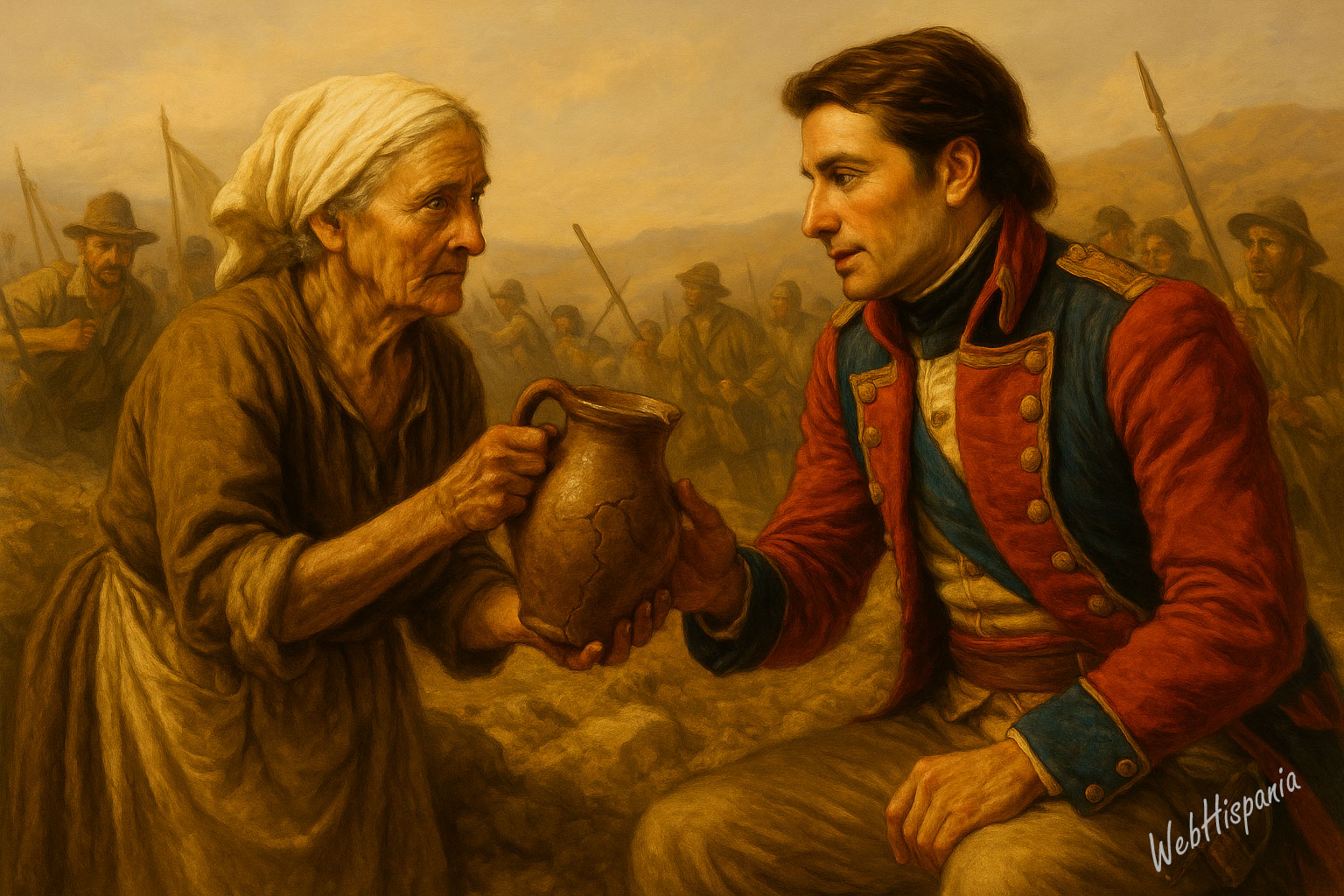
“Water for Spain, even under fire.” Bellido steadies her broken jug while Reding drinks. (AI-generated)
The Shattered Pitcher: Chronicle of an Instant
Around nine in the morning, Reding observed the French line from a threshing floor beside the royal road. Witnesses Bonifacio de Ulrich and Ramón Cotta agree that a chain of women reached the 12‑pounder battery beside the general. Maria offered her pitcher; in that instant a projectile smashed it. Unfazed, she scooped the remaining water with her blood‑speckled fingers and held it out to Reding. The general blessed her: “You too uphold Spain.”
That gesture alone did not win the battle, but it is a metaphor for what kept the Spanish army standing: logistics turned into courage, courage turned into identity.
Popular Heroism vs. Academic Skepticism
- Tradition
Carrero (1815) praises “the heroic women who, scorning the fire, reached the cannons.” Benito Pérez Galdós, in his novel Bailén (1873), dramatises the scene: “Women braved the fire, entering the most dangerous places and carrying their pitchers to the centre artillery.” - Critique
Later historians have called Maria Bellido a patriotic myth. Colonel Manuel López Pérez (1966) admits the scarcity of documents yet unearths baptismal records and wills confirming Maria Paula Bellido’s existence: married, childless, and deceased in Bailén, March 1809.
Legend or not, the episode mirrors a collective reality. Water‑bearers existed: without them, cannons would have overheated and troops might have surrendered — as happened to the French crying “L’eau! L’eau!” before capitulating.
Women, Hispanidad, and People’s War
Anglophone historiography often frames the Peninsular War through Wellington, treating guerrillas as romantic folklore. We reclaim popular Hispanidad: women such as Agustina de Aragón, Manuela Malasaña, and Maria Bellido did more than fire muskets; they sustained national morale.
Bellido’s pitcher embodies Spanish social unity: clergy, military and common folk aligned in defence of the Fatherland and the legitimate Monarchy.
After the Gun‑smoke: Oblivion and Revival
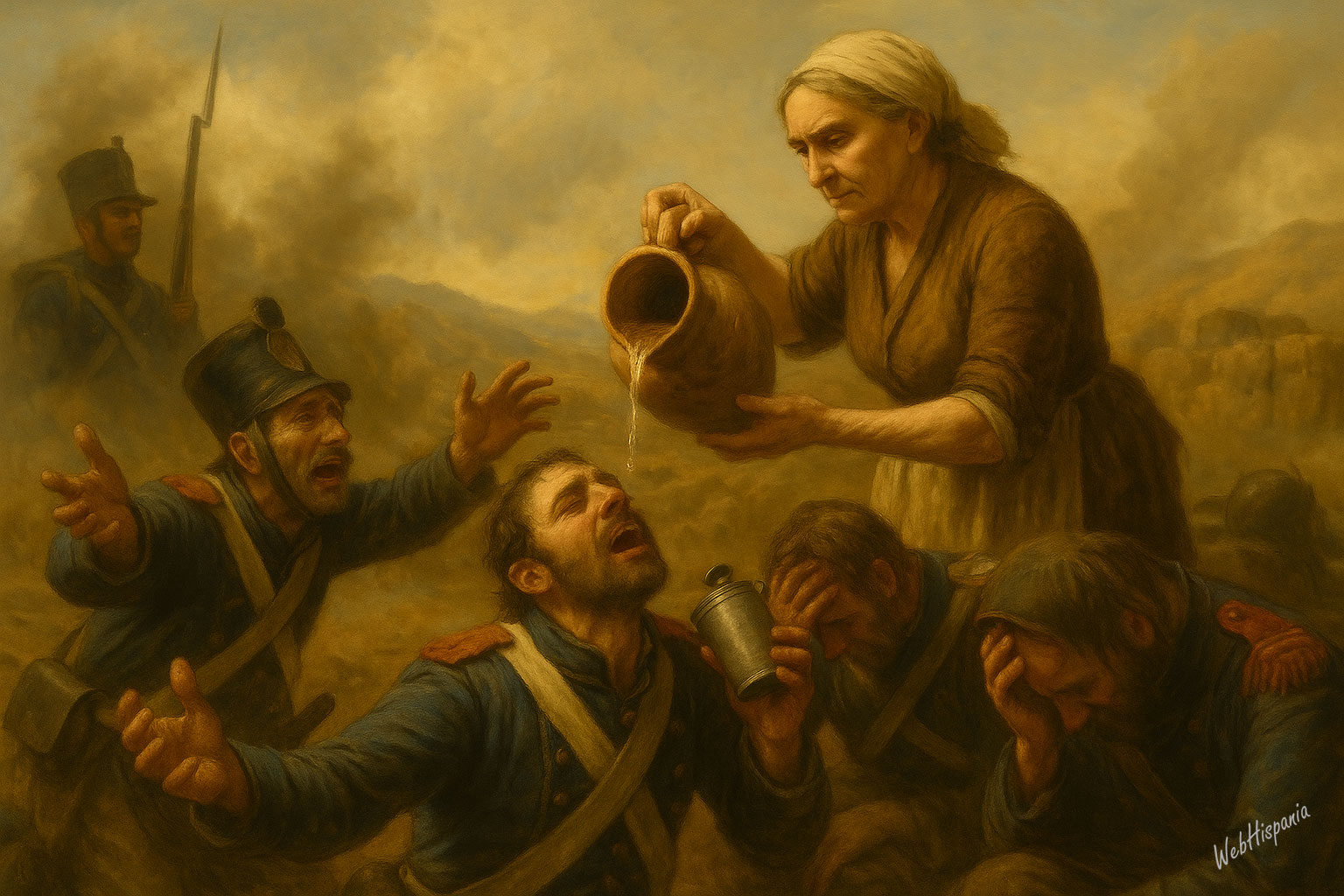
“L’eau… s’il vous plaît.” Thirst, not steel, makes the Eagles bow before a Spanish pitcher. (AI-generated)
Maria died during an epidemic in 1809; her husband shortly after. French troops desecrated graves; her remains likely lie in Bailén’s communal pit. In 1850 a military commission praised Bailén’s townsfolk, but her specific name vanished.
Only in 1862, when Queen Isabel II visited Jaén, did chronicler Francisco Rentero publicly mention “the heroine of the pitcher.” Yet the statue erected in the square honours “Victorious Spain,” not Maria herself.
Today her street — the old Carrera — is Calle María Bellido, and the Battle of Bailén Museum displays a replica shattered pitcher.
Conclusion – A Lesson of Living Water
Beyond cannons and strategy, Spain’s secret weapon at Bailén was humanity: women who turned water into moral gun‑powder. Maria Bellido embodies the cry echoing through History: Hispania does not yield.
Remembering her is not folklore; it is historical justice. Bailén was Napoleon’s first open‑field defeat, and without one anonymous water‑carrier’s courage the outcome — and later narratives — might have differed.
So when we speak of heroes, let us recall the woman whose pitcher — shattered yet brimming with dignity — helped crack Napoleon’s lightning. Her name, Maria Paula Bellido Vallejo, deserves a seat of honour in Hispanic memory.
Sources
- Carrero AJ. Bailén. Descripción de la batalla y auxilios que en ella dieron sus vecinos. Jaén; 1815.
- Galdós B. Bailén. Episodios Nacionales, 1st series, 1873.
- López Pérez M. “María Luisa Bellido, la heroína de Bailén.” Revista Ejército. 1966;(20):59‑79.
- Provincial Historical Archive of Jaén. Notarial protocols of Luis Domingo Cobo and Maria Bellido (1801‑1809).
- Diocesan Archive of Jaén. Baptismal Book XVI, Parish of the Assumption, Porcuna, folio 256.
Share this article
On this day
- 1690 The excellent Baroque painter Juan de Valdés Leal, nemesis of Murillo and famous for his "Vanitas" in the Hospital de la Caridad, dies in Sevilla.
- 1940 At dawn, Lluís Company y Jover, President of the Generalitat de Catalunya, is shot by a picket of soldiers at Montjuic Castle for the crime of military rebellion.
History of Spain