
Source:Libertad Digital
Ukraine belongs to what one historian has coined “the lands of blood”. Today we can sadly paraphrase that famous expression: “Poor Ukraine, so far from God and so close to Russia”
The first thing to say is that, as one might expect, the conflict we are witnessing with horror these days does not come from yesterday, or even from the Soviet past of Russia and Ukraine.
Without needing to wander into the recesses of Eastern European history, we can identify 1764 as the year in which Ukraine was divided between Poland (another great victim that had previously been an executioner and would later be divided between its powerful neighbours – the wheel of history’s misfortune) and Russia. This division, by the way, is at the origin of the differences between Ukrainian territories that continue to this day.
For our purposes, the part annexed by Tsarist Russia was intensely Russified, by banning the use of the language in many areas, forced emigration of the Russian population to Ukrainian cities, deportation of Ukrainians to Siberia, discrimination, and so on. Although this is a light version of what was to come, the building blocks were already there.
The outbreak of the Russian revolution was used by some of its territories to declare independence: Finland did well, Ukraine very badly. Its virtues are its greatest attraction for its powerful northern neighbour: it became the breadbasket of the Soviet Union, a country dramatically in need of grain during its long existence.
The process of forced collectivisation undertaken by the communist party leadership had in Ukraine, in the Ukrainian peasants, one of its most tragic victims.
We know what happened: the country born of the Bolshevik revolution decided that it needed as much grain as possible for the process of accelerated industrialisation of the territory. In its atavistic, doctrinal hatred of the peasantry and its boundless voracity, the regime sent its executioners (since they brought death to every corner of Ukraine) to extract every last grain they could pluck from those unfortunate peasants.
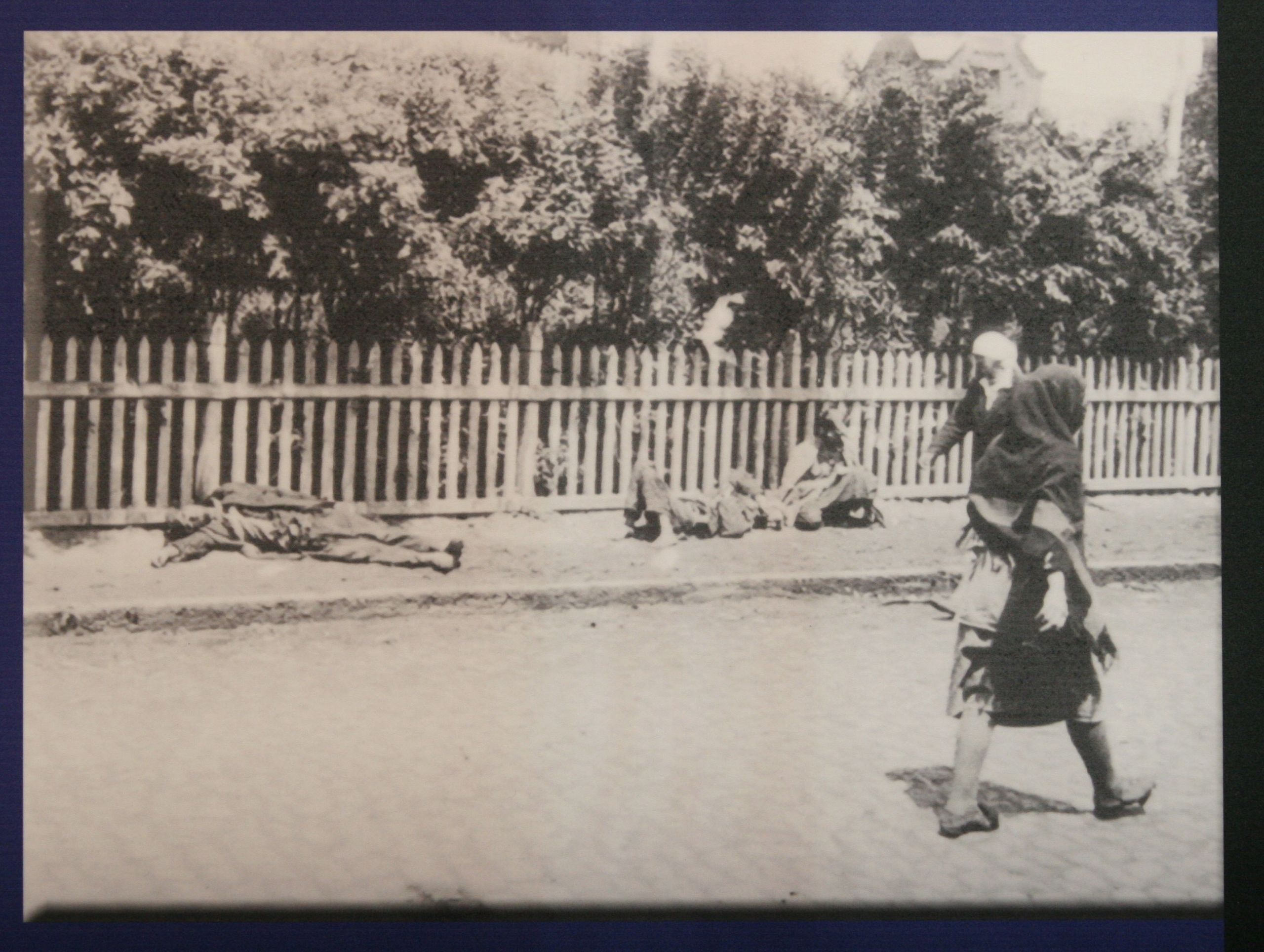
Corpses on the streets of Ukraine, victims of Stalinist famine.
In their blind greed they seized even the most sacred thing for a peasant: the reserve grain for the next sowing period. Bolshevik voluntarist optimism, or rather their ruthless planning, unleashed what is probably the greatest famine in history outside Asia: at least five million dead in the USSR, four million of them in Ukraine. They knew what they were doing: Stalin received countless messages of the looming tragedy, including from his Russian and Ukrainian co-religionists, but ignored them.
They were not content to push the Ukrainian peasantry to the edge of survival, but forbade them to move to the cities in search of a meagre meal, so that many left a trail of corpses on the roads. The ruthlessness reached unthinkable limits even in wartime, let alone peacetime.
If you have the will and the stomach, Anne Applebaum‘s account of the Holodomor (the famine), like everything else she writes, is impeccable. And she argues unequivocally that the Soviet state orchestrated the catastrophe to get rid of a political problem.
No wonder that when the German army entered Ukraine in 1941, many of its inhabitants went out to greet them with bread and salt (Slavic peasant tradition) because, in their ignorance (poor naivety), they believed that they were coming to liberate them…, or at least they thought that nothing could be worse than what they had suffered a decade earlier. But the most extreme version of war awaited them, the bloodiest and most savage that history has ever seen. Ukraine belongs to what one historian has aptly coined “the lands of blood”.
After World War II and until the declaration of independence in August 1991, Ukraine was one of the republics of the Soviet Union and thus a territory subject to Moscow’s designs, at the whim of whoever held power in the Kremlin.
Ukraine thus has many historical reasons to be wary of Putin’s expansionist ambitions, as well as every right to choose its own destiny.
Of course we (almost) all regret and condemn this new Russian aggression against a smaller and therefore less strong neighbour, but as far as we in Europe are concerned, we should learn from our own mistakes and begin to realise that the East has always been a rougher world; democracy is barely an aspiration there, or simply does not exist; the military is subject to more difficult, extreme tests; being different is paid for with your health or your life; and even the prisons are places without compassion. What if Putin were to set his sights on Germany, or the Baltic Republics?
What we might call, to borrow someone else’s title, “the process of civilisation” is worthy of appreciation, but if your neighbour is a wolf you can’t organise sheep-model parades, or try to appease him with diplomatic talks, because the outcome is obvious.
In this age of “post-heroic societies”, where almost all of us have grown a buffer of satisfied bourgeoisie, Putin has starkly reminded us of our fragility. If Ukraine falls, we are one step away from the jaws of the wolf. Closer than ever in recent history. And we were not used to this kind of scenario, would we be able to cope with it, if it comes to that?
Who knows.
The only certainty is that today we can sadly paraphrase that famous expression: “Poor Ukraine, so far from God and so close to Russia”.
Share this article
On this day
- 1177 Reconquista: Alfonso VIII and Alfonso II surrender Cuenca after nine months of siege.
- 1292 Reconquista: Sancho IV conquers Tarifa after an economically exhausting campaign.
- 1526 Spanish pilot Bartolomé Ruiz landed at and gave name to San Mateo de las Esmeraldas Bay in Ecuador.
- 1551 The Royal University of México was founded, the first in North America, created by a Royal Decree of Emperor Carlos V and signed in his name by prince Felipe in Toro, Zamora.
- 1558 Carlos V dies in Yuste.
- 1794 Malaspina's expedition returns.
- 1832 British writer Walter Scott dies.
- 1895 Juan de la Cierva y Codorníu (d. 1936) is born in Murcia.
History of Spain