


Source:Libertad Digital
New warning to the Government from the Council of Europe: it reminds it once again that judges must participate in the election of the CGPJ.
the Group of States against Corruption (GRECO), part of the Council of Europe, has lamented the “lack of positive” and “tangible” progress regarding the system for electing the General Council of the Judiciary (CGPJ) and has urged Spain to undertake a reform in which its members are given a “voice” and “consulted”.
This is what emerges from its report on the implementation in Spain of the recommendations it has been making to our country on anti-corruption measures regarding parliamentarians, judges and prosecutors. The dossier analyses whether and, if so, how Spain has implemented the recommendations made in this area by GRECO itself during the fourth evaluation round.
The fifth recommendation of this document – out of a total of 11 – is, for GRECO, the only one in which Spain has not complied. The group had called on Spain to conduct an evaluation of the legislative framework governing the CGPJ and its impact on the actual and perceived independence of this body from undue influence, with a view to addressing any shortcomings identified.
In this line, GRECO urges “the authorities to implement the recommendation without delay” and also stresses that in doing so “it is extremely important that the judiciary is consulted and has a say in key decisions regarding its functioning and priorities”.

But they also state that “the necessary discussions in this regard with other branches of government should take place in a climate of mutual respect and take particular account of the preservation of the independence and impartiality of the judiciary”.
The election of the CGPJ, “a critical issue”
The report’s conclusions put the spotlight on what they see as “a critical issue: the system of selection of the CGPJ and its perceived politicisation“. “This is a cause for concern, as the CGPJ is responsible for some crucial decisions in the judiciary, including the appointment of judges to senior positions and disciplinary matters,” they recall.
According to GRECO, the information provided by the Spanish authorities “does not add anything new to what had already been analysed in the 2013 fourth round evaluation report”. Today, they point out, “the situation is exactly the same, and the concerns expressed in light of it remain the same, if not more so, than before”.
“At that time, GRECO stressed that one of the most notable objectives of a judicial council, whenever it exists, is to safeguard the independence of the judiciary, both in appearance and in practice. It further pointed out that the result in Spain had been quite the opposite, as evidenced by repeated public concern in this area,” they explain.
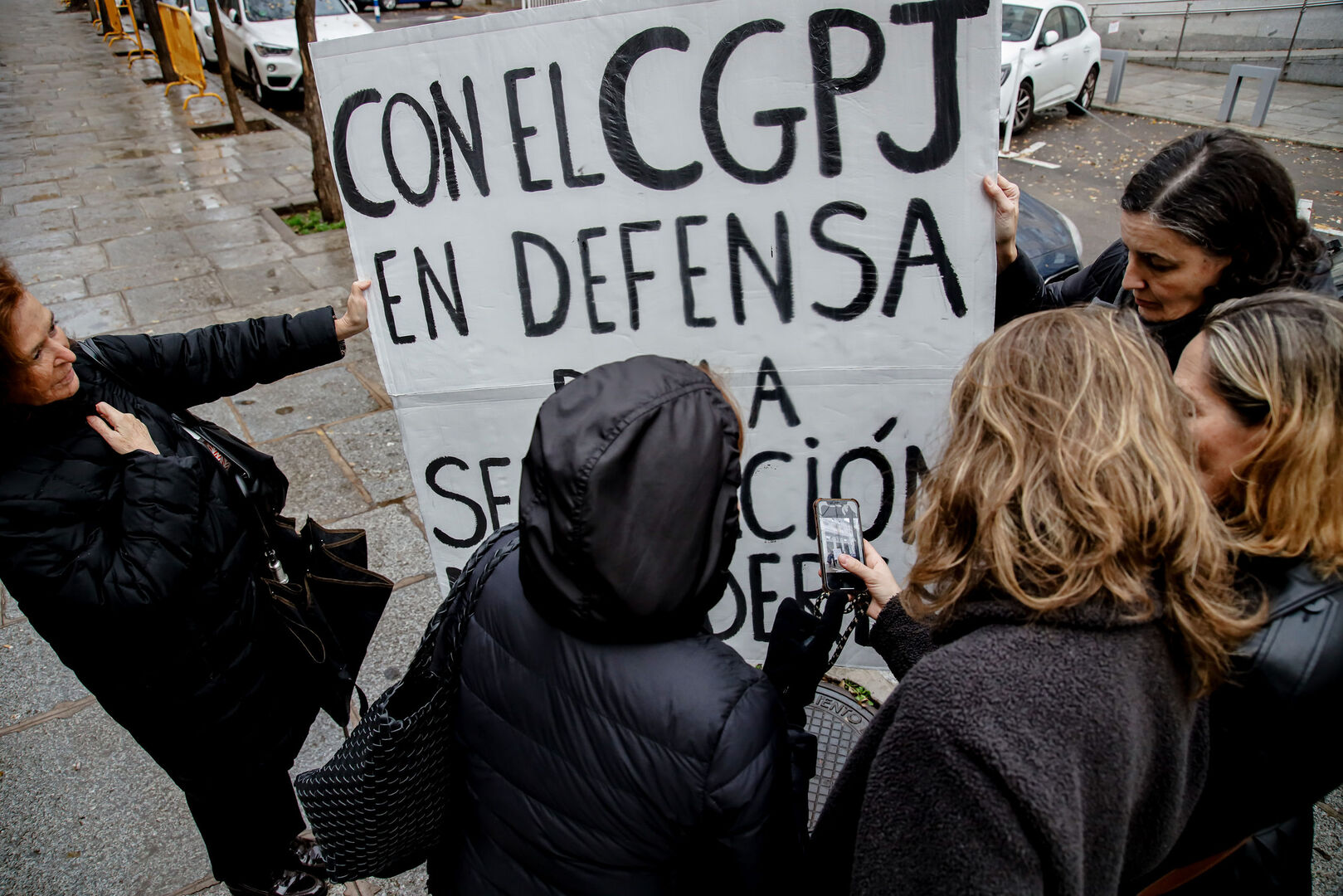
The group insists that it has already pointed to the “applicable Council of Europe rules on the election of judicial members of judicial councils”. These state that “where there is a mixed composition of judicial councils, for the selection of judicial members, it is advised that they should be elected by their peers, following methods that ensure the broadest representation of the judiciary at all levels”.
It criticises the latest PSOE and UP proposal
In addition, it stresses that “political authorities, such as the Parliament or the executive, should not be involved at any stage of the selection process”.
The report also notes that “whenever a renewal of the CGPJ has taken place, misgivings have been expressed about political bargaining and for the appointment of key judicial posts”.
One of the most significant sections criticises the proposal to reduce the majorities for appointing members of the CGPJ proposed by PSOE and UP: “More recently, a deadlock (more than two years) in the appointment of the CGPJ, led a number of parliamentary groups to present a bill to unblock the system”, they explain and recall that for “GRECO (together with other key international actors in this field, including the European Commission and the European Association of Judges) expressed its concern about the aforementioned proposal“, they recall.
They also criticise that a few months later a new proposal was presented to “prevent the CGPJ from making discretionary appointments when in office”, which has also “been criticised by judges and by the judges’ governing body itself”.
One Comment
Leave A Comment
You must be logged in to post a comment.
Share this article
On this day
- 1621 The city of Santiago de Veraguas (Panama) is founded in the viceroyalty of Peru.
- 1702 The Indies Fleet that left Cadiz in 1699 for New Spain was sacked on its return in the Strait of Rande (Vigo) by Admiral Rooke's fleet. In spite of the English publicity, most of the treasure managed to be unloaded.
- 1730 The city of San Antonio de Areco (Argentina) is founded in the Río de la Plata Governorate of the Viceroyalty of Peru.
- 1739 British PM Robert Walpole declares what was to become known as the War of Jenkins' Ear. During this war, some of the most heroic episodes of Spanish arms took place.
- 1940 Hitler meets with Franco in Hendaye to discuss three issues: French resistance, the possibility of Spain's intervention in "Operation Felix" to conquer Gibraltar and Spain's entry into World War II.
History of Spain




[…] an end to the “perception of politicisation”. Thus, the Council of Europe insists that it should be the judges who elect its members, in line with European standards, a proposal taken up by the Popular Party with Pablo Casado as […]