

May 16, 2025
Source: Web Hispania
In 1589, the British Empire sent Francis Drake to deliver a fatal blow to a weakened Spain. What they didn’t count on was María Pita—a butcher’s wife from Galicia who took up arms, killed an English officer, and turned the tide of the siege of La Coruña. This is not just a story of resistance. It’s a challenge to the imperial narrative that erased her. A Spanish woman made Drake retreat. History just didn’t want to talk about it.
In May 1589, a butcher’s wife from Galicia became a symbol of resistance against the English Empire. You may already know the story—how María Pita killed an English officer and turned the tide of the siege of La Coruña. But beyond that moment lies a deeper truth. She didn’t ask for permission—she took up arms, stood her ground, and led a city to defy one of the most feared fleets in history. This is not just a retelling. It’s a closer look at the woman behind the legend—her life, her battles, and the legacy she left behind. The Spanish woman who made Francis Drake retreat … and carved her name into history.
A Heroine Born from Fire, Not Myth
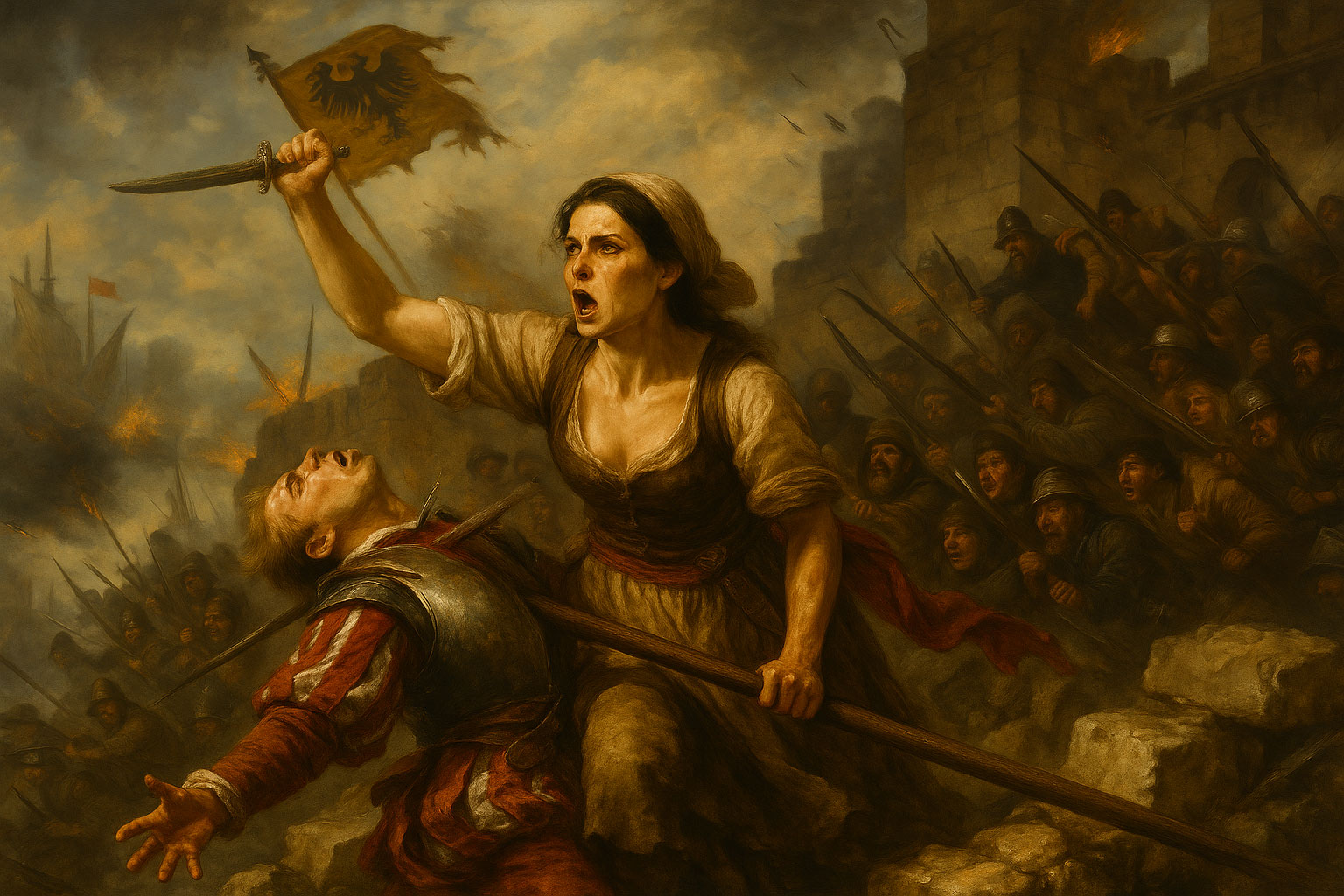
María Pita strikes back. (AI-generated by ChatGPT, based on historical sources and artistic direction.)
The Anglo-centric version of history would have us believe that Francis Drake was unstoppable, a noble privateer who sailed boldly across the oceans, civilizing and commanding wherever he went. Spain remembers him differently.
In 1589, while still nursing the wounds of the failed invasion attempt, Spain faced a brutal counterattack. England launched what it hoped would be a decisive blow: the Counter Armada, led by Francis Drake and General Norris, with over 140 ships and 20,000 men. Their objective? Invade Iberia, dethrone Philip II, and seize dominance over the Atlantic.
La Coruña wasn’t supposed to be the main target. Drake simply thought it would be easy. He was wrong.
María Pita Before the Siege
María Mayor Fernández de la Cámara y Pita, known simply as María Pita, lived in the fishing district of La Coruña. She was married to Gregorio de Rocamunde, a local butcher. Her life was ordinary—honest, laborious, and invisible to history. Until it wasn’t.
When the English fleet appeared on the horizon in early May, María was one of many civilians caught in the crosshairs. The city’s defenders were outnumbered and ill-equipped. Still, they resisted. Among them was María’s husband—until he was killed in action.
And that’s when María Pita changed the course of history.
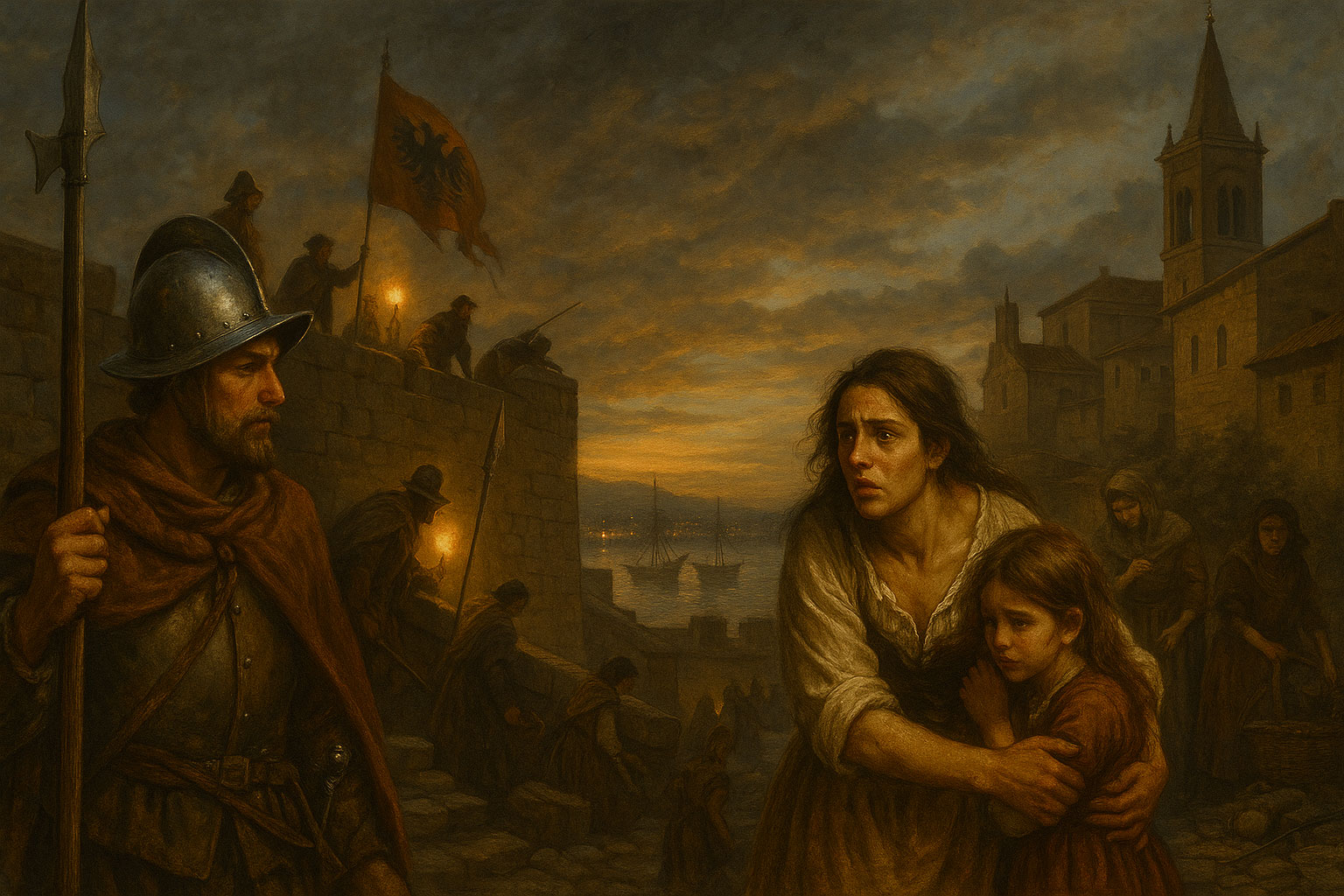
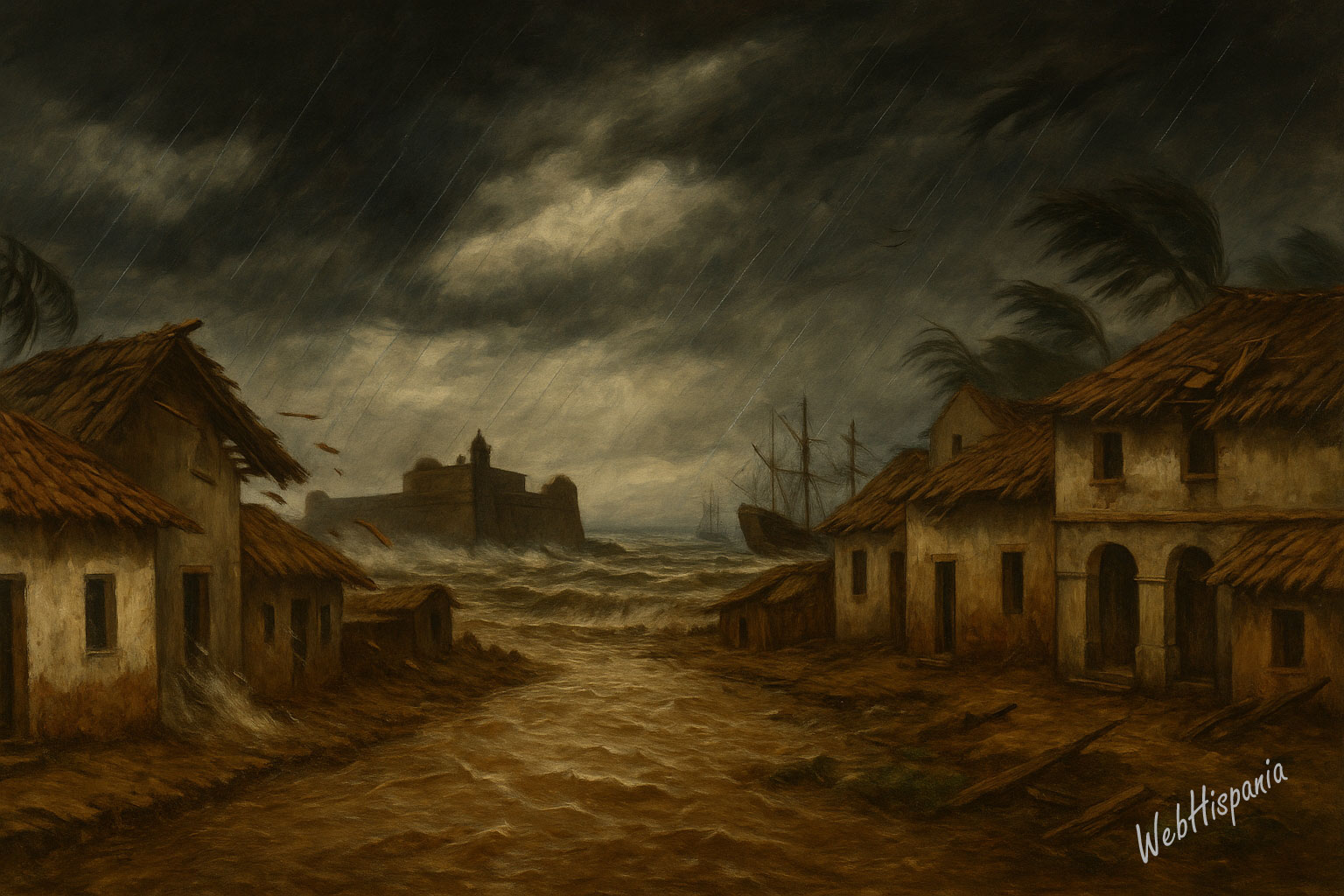
The night before. (AI-generated visual interpretation by ChatGPT.)
One Woman, One Cry
The English breached the city walls. Their officer, young and emboldened, climbed the barricades holding the enemy banner aloft—ready to claim La Coruña.
María Pita, standing beside her dead husband, saw the flag and the man who held it. She picked up a pike, fought her way forward, and struck him down, ripping the banner from his grasp.
Then she shouted words that lit a fire in the souls around her:
“Quen teña honra, que me siga!”
(“Whoever has honor, follow me!”)
And they followed. The defenders, inspired by the sight of a woman covered in blood and defiance, pushed back. The English line faltered. Their advance turned into retreat.
Drake’s plan had collapsed—not because of cannons or castles, but because of one woman who refused to yield.
Recognition from a Reluctant Crown
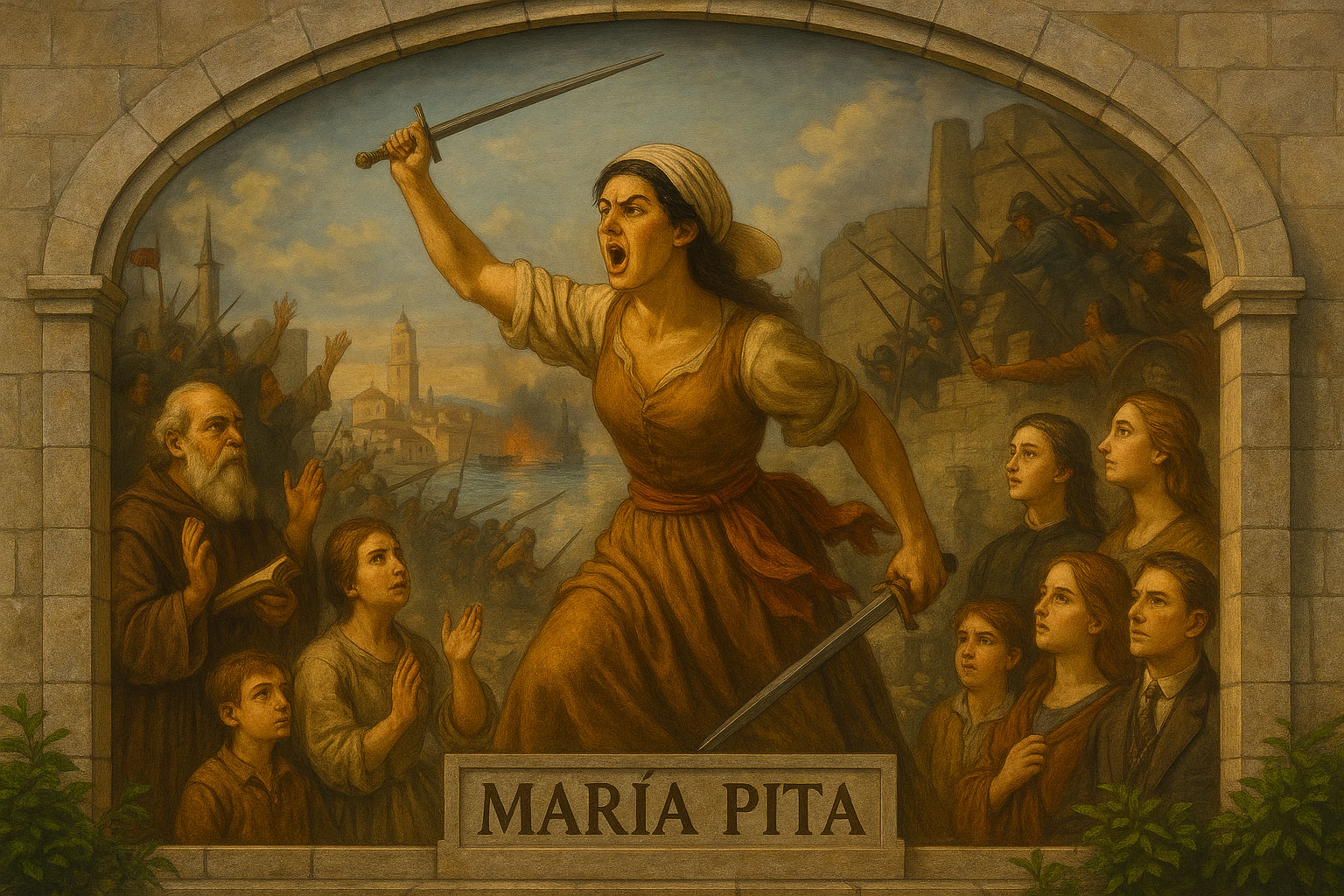
Legacy. (AI-generated composition designed by ChatGPT.)
When word of María’s actions reached Philip II, even the often-indifferent monarch took notice. She was awarded the rank of ensign and granted a royal pension.
But recognition in Madrid did not mean reverence in Galicia. María’s rise from fishmonger’s wife to war heroine upset the social order. She remarried, acquired property, and clashed with local elites who scorned her for daring to rise above her station.
They could tolerate her courage. What they couldn’t tolerate was her survival.
The Woman Behind the Legend
María Pita lived four lives: as a worker, a wife, a warrior, and eventually, a woman of means. She married four times, buried multiple husbands, raised children, and fought legal battles over land and inheritance.
Despite being illiterate, she outmaneuvered lawyers and landowners alike. She defied not only Drake, but an entire social system designed to forget women like her the moment the war drums faded.
She never asked to be remembered. But she left them no choice.
A Challenge to the English Narrative
Drake’s retreat from La Coruña is often glossed over—or omitted entirely—in British historical accounts. The Counter Armada was a humiliating failure, far worse than Spain’s own in 1588. But where the Armada’s failure became myth in English lore, its counterpart was quietly buried.
It is no accident that María Pita’s name is rarely spoken in English classrooms. She stands as proof that empire is not destiny. That resistance is not futile. That courage is not the sole property of kings, queens, or admirals.
She was none of those. And yet she won.
Why Her Story Still Matters
María Pita’s story is not only about a single heroic act. It’s about disrupting the idea that history is a straight line leading to British dominance. It reminds us that Spain had its heroes, its victories, and its women who made a difference—not in courtly salons, but on the bloodied walls of besieged cities.
Today, her statue stands in the heart of La Coruña, pike in hand, unflinching gaze fixed forward. Around her, a plaza bears her name. Beneath her, the remains of an empire once dared to tread.
María Pita’s legacy is not just local or national. It is universal. She is the voice that says you don’t need a crown to defy one, the spirit that reminds us that history belongs to those who act—not just those who write it.
So next time someone tells you Francis Drake was unbeatable, tell them about the woman who beat him. Tell them about María Pita. The Spanish woman who made Francis Drake retreat … again.
Sources
- Sotto y Montes, J. de. (1966). Semblanzas de algunas heroínas españolas. Revista Ejército, (20), 51–77.
- Batán, T. (s.f.). María Pita, la coruñesa que se enfrentó al pirata Drake Revista de Historia. [Traducción aquí].
- Feijoo, B. J. (1726–1739). Teatro crítico universal. [Fragmento citado en Sotto y Montes, 1966].
- Castro, C. de. (1929). Las mujeres del Imperio. Madrid: Imprenta y Editorial Reus. [Citado en Sotto y Montes, 1966].
- Archivo General de Simancas. (s.f.). Documentación relativa a la defensa de La Coruña y la pensión real concedida a María Pita. [Citado en Sotto y Montes, 1966].
Share this article
On this day
No Events
History of Spain