


June 29, 2025
Source: Web Hispania
As Spain’s empire faded into memory, fifty soldiers stood their ground in the remote church of Baler—defying hunger, disease, and abandonment. For 337 days, they fought not for victory, but for duty and dignity, unaware that their homeland had ceded the Philippines to the United States. Their story, drawn from forgotten census records, war diaries, and eyewitness reports, is more than a military episode—it is a final heartbeat of a vanishing world.
In the twilight of the Spanish Empire, one of its last acts of defiance took place not on the grand battlefields of Europe or the Americas, but in a remote village on the eastern coast of Luzon. There, in the town of Baler, fifty Spanish soldiers withstood a siege that lasted nearly a year—unaware that Spain had already surrendered the archipelago to the United States. Their resistance, born not of hope for reinforcements but of stoic honor and imperial inertia, became the final chapter of more than three centuries of Spanish presence in the Philippines.
The Siege of Baler (1898–1899) is often romanticized, but behind the legend lies a painful narrative of miscommunication, hardship, and forgotten sacrifice. Thanks to period accounts, a census from 1876, and the analysis of military life by historians such as Manuela Caballero and Paul César López Romero, we can reconstruct the siege not merely as a heroic footnote, but as a human drama reflecting the collapse of empire.
An Empire in Decline

AI-generated image. The church of Baler — a bastion of resistance on the edge of empire.
By the 1890s, Spain’s empire was faltering. Cuba was in revolt, Puerto Rico increasingly restless, and the Philippines was in open rebellion. In 1898, the Spanish-American War shattered Spain’s last overseas claims. Within weeks, the United States defeated Spanish forces in both the Caribbean and the Pacific. The Philippines, governed through a complex colonial administration that increasingly relied on religious orders for local control and the Guardia Civil for maintaining order, fell into institutional collapse as traditional chains of command broke down.
The Treaty of Paris, signed in December 1898, formalized Spain’s cession of the archipelago to the United States. But for those stationed in remote regions such as the Distrito de El Príncipe, news traveled slowly—if at all. According to the 1876 census, the district was sparsely populated, lacking basic infrastructure. Baler was a coastal town with no reliable overland access to Manila. The journey could take weeks, passing through mountains, rivers, and jungle, often under the threat of ambush.
This geographical isolation meant that while Manila fell under U.S. control and Aguinaldo’s rebels advanced, the soldiers in Baler were left unaware—or in disbelief—of the war’s outcome. For them, the Empire still stood.
The breakdown of colonial administration was compounded by the fragmentation of imperial command structures. Orders from Manila often conflicted with field intelligence, and many garrisons received contradictory instructions about whether to resist, evacuate, or negotiate. This institutional confusion reflected the broader disintegration of Spain’s capacity to govern its remaining territories.
The Church and the Soldiers
In July 1898, under Lieutenant Juan Alonso Zayas, a detachment of the 2º de Cazadores Expedicionarios was stationed in Baler to reinforce the town and suppress Filipino revolutionary activity. When Zayas died of disease shortly after the siege began, command fell to the more resolute Lieutenant Saturnino Martín Cerezo.
The choice of the church as a defensive bastion was strategic. Constructed of stone, with limited access points, it could be effectively fortified. The soldiers dug trenches, stockpiled food, and prepared for prolonged defense.
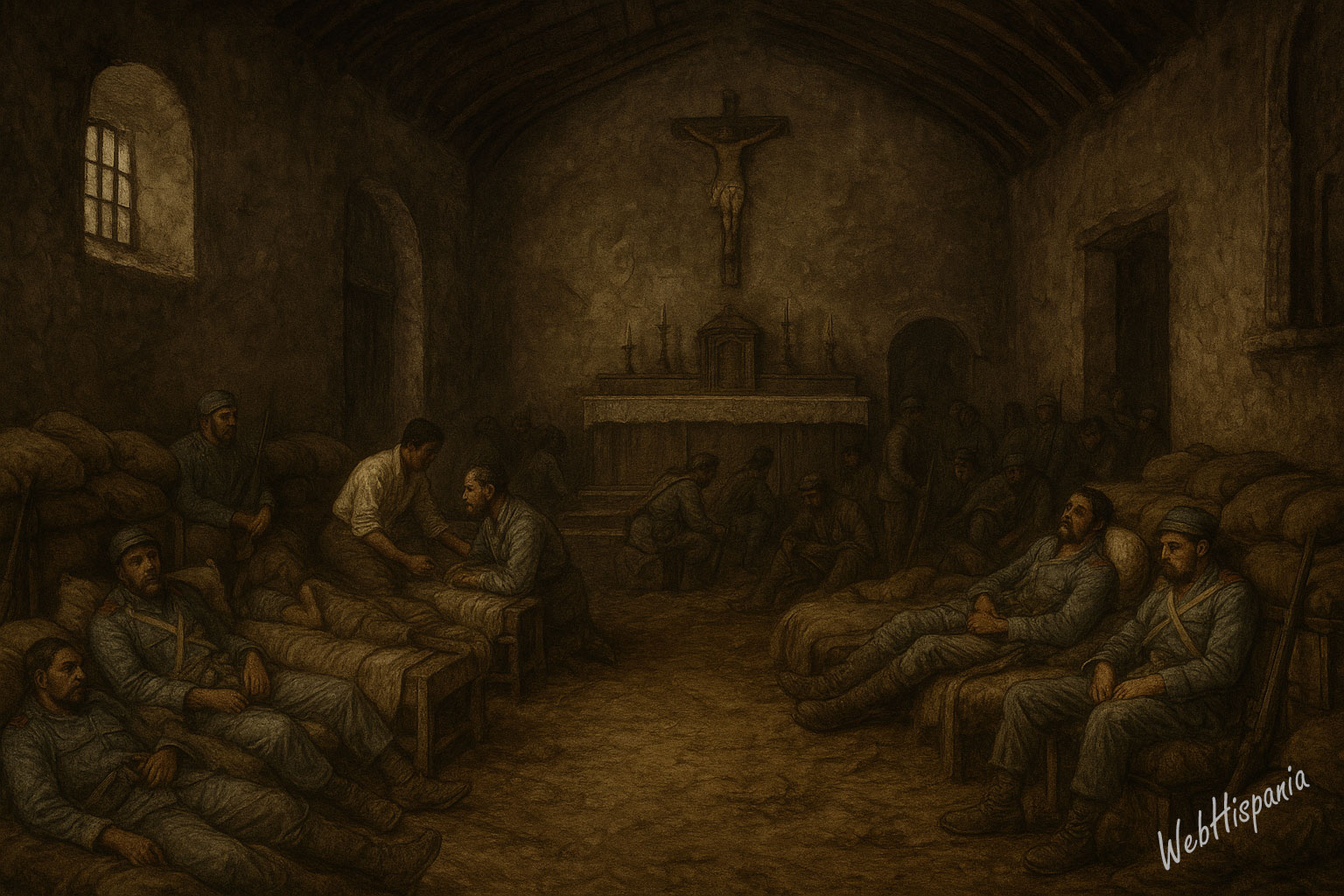
AI-generated image. The church became home, fortress, and tomb during the 337-day siege.
Most of the men were conscripts drawn from Spain’s rural provinces or colonial volunteers—young, poorly remunerated, and unaccustomed to the tropical climate. Historian Manuela Caballero documents that many colonial troops deployed to the Philippines suffered from malnutrition and tropical diseases even before engaging in combat. Unit cohesion was maintained through military discipline, routine, and the conviction that the Spanish crown had not abandoned them.
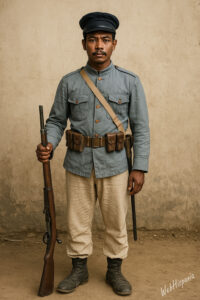
The garrison included both peninsular Spaniards and Filipino loyalists who had served the colonial administration. Their uniforms, adapted to tropical conditions, featured light canvas tunics and locally procured headwear when standard equipment deteriorated. Their small cache of Remington rifles was meticulously maintained, though ammunition reserves were severely limited.
-
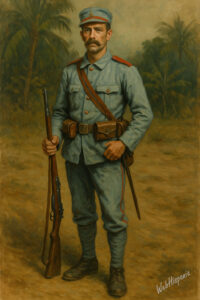
- AI-generated image. Spanish cazador stationed in the Philippines during the final days of empire.
-
- AI-generated image. A native Filipino serving the Crown in Baler.
-
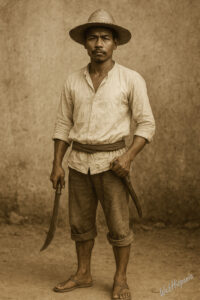
- AI-generated image. A Filipino fighter of the revolutionary army facing colonial resistance.
The local civilian population, caught between revolutionary forces and colonial authorities, occupied an increasingly precarious position. Some provided clandestine assistance to the defenders through intelligence or supplies, while others withdrew into the surrounding forest. The siege effectively shattered the delicate accommodation that had previously existed between the colonial state and local communities.
The Siege and the Silence
On June 27, 1898, Filipino revolutionary forces under Aguinaldo’s command encircled the church. Over the following 337 days, they employed various tactics to force Spanish surrender: direct assault, siege warfare, and psychological pressure.
Food supplies deteriorated rapidly. The garrison was reduced to consuming cavalry horses, spoiled rice, and eventually foraged roots and scraps. Monsoon rains flooded their defensive positions. Tropical diseases—beriberi, dysentery, and various fevers—decimated their numbers. Several soldiers lost their sight due to severe malnutrition.
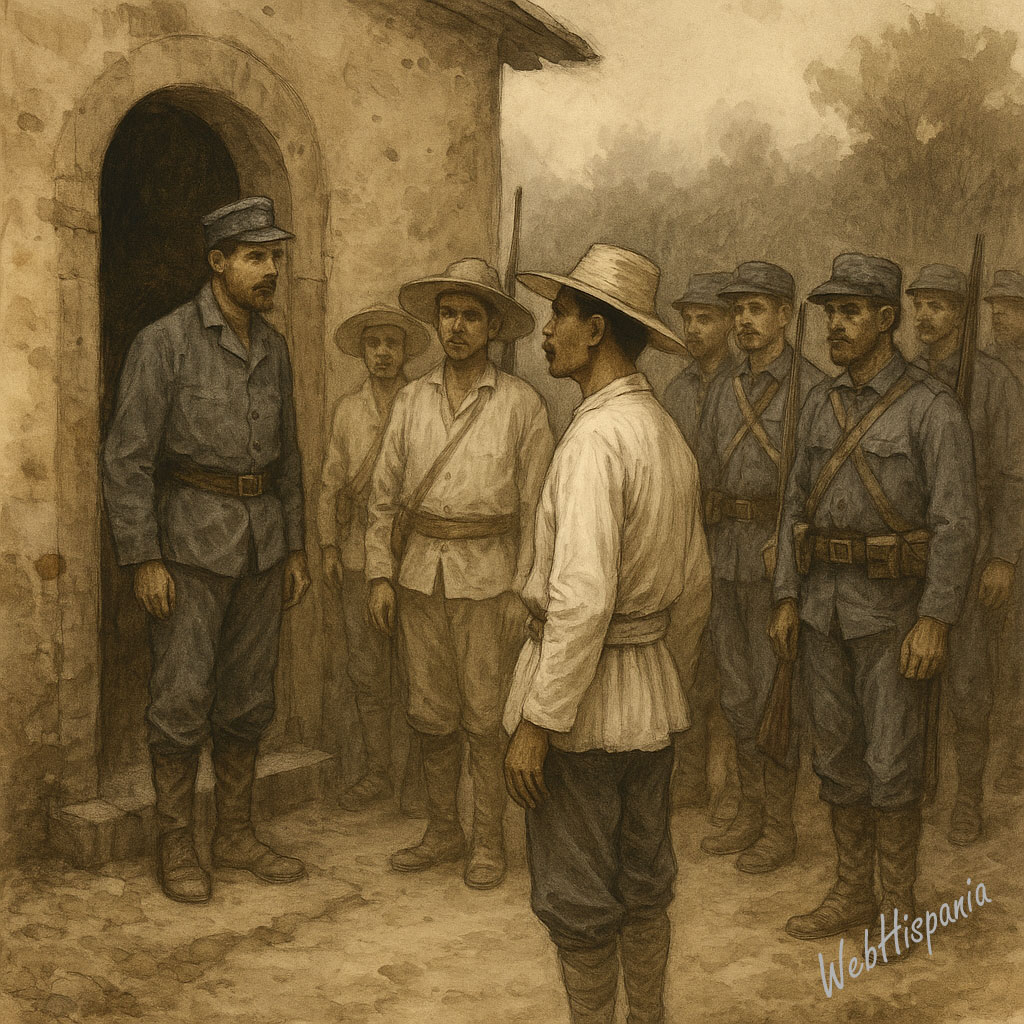
AI-generated image. When enemies met face to face, diplomacy and dignity held their ground.
Throughout the siege, the besiegers attempted to convince the defenders that the war had concluded. Newspapers were delivered across the lines, letters were transmitted, and emissaries—occasionally accompanied by clergy—urged capitulation. Martín Cerezo rejected all such overtures, suspecting deliberate deception.
The defenders maintained detailed records throughout the siege. One corporal, documenting conditions in his journal, noted the profound silence that followed each exchange of gunfire: “No birds. No people. Just the sound of our own breathing.”
Notably, the revolutionary forces demonstrated considerable restraint. Medical supplies for wounded defenders were occasionally permitted to pass through the siege lines. Gunfire ceased during religious observances. At least once, both sides exchanged letters acknowledging mutual respect for the other’s courage—unusual gestures in colonial warfare.
The church structure itself steadily deteriorated under siege conditions. Wooden supports collapsed. The floor became waterlogged. Vermin proliferated throughout the building. Despite these conditions, Cerezo insisted on maintaining military protocols: daily roll calls, uniform standards, and religious services. These rituals of imperial order served as psychological anchors against despair.
The Final Letter
By May 1899, fewer than twenty soldiers remained capable of combat duty. At that juncture, a communication arrived from Spanish officers now serving under American protection in Manila. After careful authentication, Cerezo was compelled to acknowledge the reality of Spain’s defeat.
The Spanish Empire had surrendered. The Philippines no longer existed under Spanish sovereignty. Their prolonged resistance had become an anachronism—the echo of a concluded conflict.
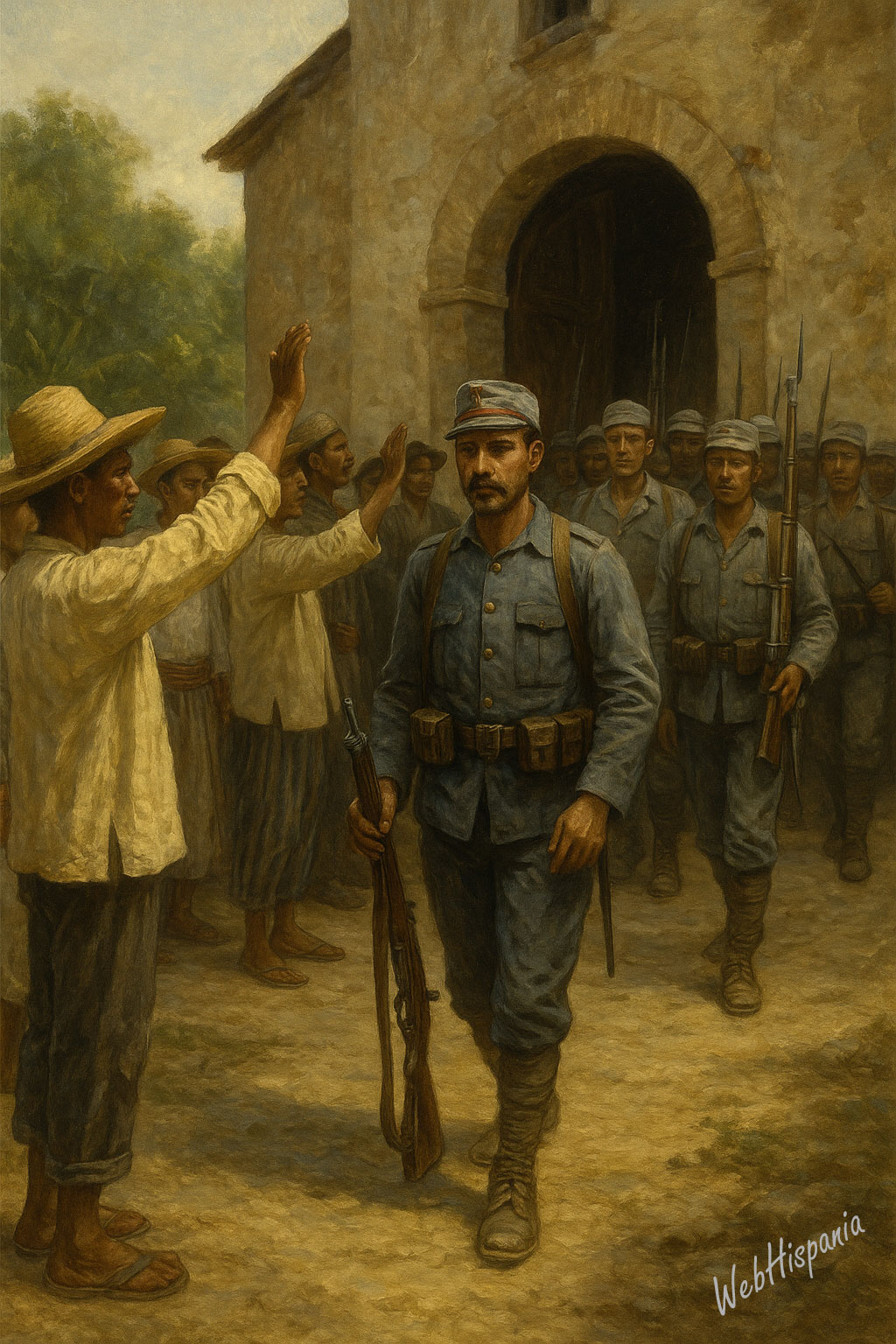
AI-generated image. The defenders leave, heads high, greeted not with hate, but with respect.
On June 2, 1899, the surviving defenders of Baler emerged from the church, their uniforms deteriorated but maintaining military bearing. The Filipino forces, many of whom had developed respect for the defenders’ determination, offered military honors as they departed.
One local witness, Pedro Enriquez, later observed: “They emerged as if victorious rather than defeated. Perhaps, from their perspective, they had achieved victory.”
Following the surrender, several Filipino combatants approached the Spanish soldiers not with hostility, but with curiosity and recognition. Food and personal accounts were shared. Photographs were taken. This mutual acknowledgment represented a rare moment of dignity in the conclusion of colonial rule.
Forgotten by All but Time
The American colonial administration, now governing the Philippines, largely ignored the incident. The Spanish government provided ceremonial recognition and medals, but by 1900, most survivors had returned to obscurity. Some resumed military careers. Others returned to Spain in silence.
Nevertheless, Baler endured in Spanish historical memory. Literary works, theatrical productions, and later films reinterpreted the siege as a final demonstration of national honor. Historians like López Romero have examined primary sources to recover the voices of those who had been marginalized as new political narratives emerged in the twentieth century.
The church building today serves both as a historical site and as a monument to forgotten sacrifice. Beneath its preserved exterior lie stories not of imperial triumph, but of institutional collapse, personal loyalty, and human endurance.
In 1945, during the Japanese occupation of the Philippines, local resistance fighters removed and concealed a commemorative plaque from the church wall until after the war’s conclusion—a quiet acknowledgment that certain principles transcend changing political authority.
Baler represented not victory, but historical instruction: that empires frequently collapse not through dramatic military defeat, but through institutional breakdown and the gradual erosion of legitimacy.
Sources
- López Romero, Paul César. “La gesta de la defensa de Baler.” Revista de Historia Militar.
- Caballero González, Manuela. Soldados en Filipinas 1564–1898.
- Censo de población de las Islas Filipinas perteneciente al año de 1876.
- Aramburu-Zabala, Eugenio. Los últimos de Filipinas: el asedio de Baler.
Share this article
On this day
No Events
History of Spain