


May 13, 2025
Source: Web Hispania
In 1797, a massive British force attempted to seize Puerto Rico and failed. This article tells the story of how Spanish troops, local militias, freed slaves, and volunteers defended San Juan against overwhelming odds. Far from the image of a crumbling empire, this was a display of unity, strategy, and heroism that deserves a place in our historical memory.
In April 1797, the history of Puerto Rico and overseas Spain wrote one of its brightest and least known chapters. A massive British fleet, under Admiral Sir Henry Harvey and General Sir Ralph Abercromby, launched an attack on San Juan with the clear objective of taking the island and consolidating British dominance in the Caribbean. They failed. In an episode worthy of the annals of heroic resistance, Spanish forces—supported by local militiamen, freed slaves, French citizens, and volunteers from across the island—repelled the assault and forced the British fleet to retreat in humiliation. It was a military, political, and moral victory that deserves a central place in our historical memory.
Spain and the Caribbean in the 18th Century
By the late 18th century, Spain maintained one of the largest empires on the planet. However, the balance of power in Europe and the world had changed drastically. England, emerging as a hegemonic naval power, sought to weaken Spain’s presence in the Atlantic and consolidate its trade routes in the Caribbean and Central America. The capture of Trinidad in February 1797 by the British was a severe blow to Spanish dominance in the Antilles. Encouraged by that success, they set their sights on Puerto Rico, “the key to the Caribbean.”
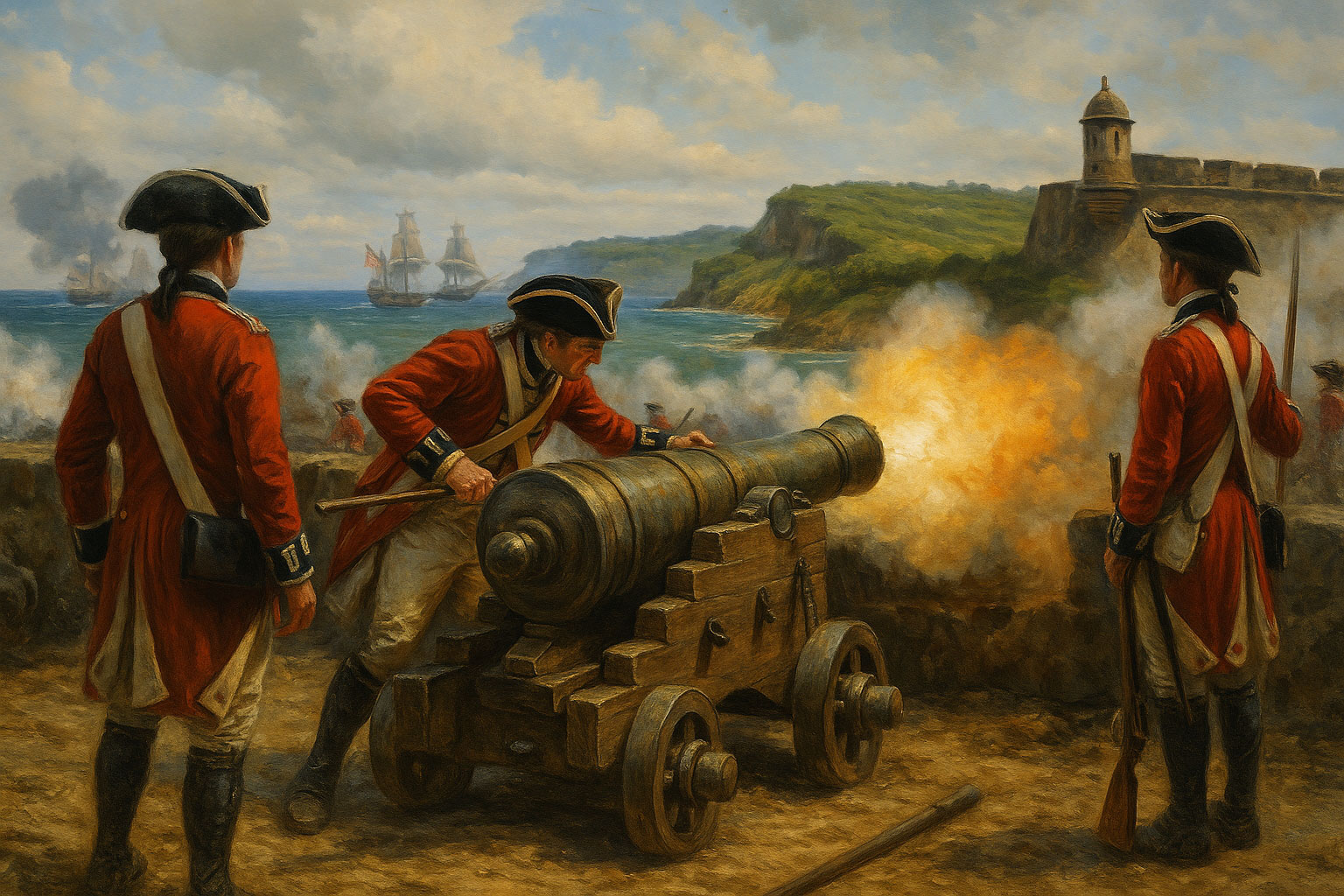
AI-generated illustration of the British landing at Cangrejos Beach — an artistic reconstruction of the 1797 Puerto Rico campaign.
The context could not have been worse for Spain. After signing peace with revolutionary France (Treaty of Basel, 1795), it had become France’s ally, reigniting conflict with Great Britain. The Spanish fleet had been defeated in February 1797 at Cape St. Vincent. Spirits in the metropole were low, but Puerto Rico was about to surprise everyone.
The Invasion Force: An All-Out Assault
The British fleet that appeared before San Juan on April 17, 1797, consisted of 68 ships, including three-deck warships, frigates, corvettes, and transport vessels. An estimated 7,000 to 13,000 soldiers made up the landing force. They were equipped with heavy artillery and a detailed plan to besiege and take the city.
Opposing them was Brigadier Ramón de Castro y Gutiérrez, governor of the island since the previous year, with barely 4,000 men: regular troops from the Fixed Regiment, disciplined militias, urban companies, freed slaves, and even convicts who volunteered. Added to this were some 300 French citizens living on the island who, after the revolution in their country, actively joined the defense. It may have looked like a ragtag resistance, but it was impressively well-organized.

Preparing the Defense: Spanish Military Science
San Juan boasted a formidable fortification system, the result of years of work and experience. The Castillo San Felipe del Morro, Fort San Cristóbal, San Jerónimo, and San Antonio formed a highly effective defensive ring. Military engineers like Juan Francisco Mestre and Tomás O’Daly had designed a deep defense line with advanced positions to halt any landing before reaching the city.
On the 17th, at dawn, lookouts spotted the enemy fleet approaching from the east. The defense plan was activated. The mobile force, led by Lieutenant Colonel Isidoro Linares, moved to block the landing at Cangrejos and Torrecilla beaches. There, Lieutenant Colonel Teodomiro del Toro became a hero of the day, resisting the initial attack and inflicting heavy losses on the British. Yet, numerical superiority prevailed, and the British established a beachhead. But they had lost the element of surprise and suffered their first attrition.
The Siege: Fire and Resistance
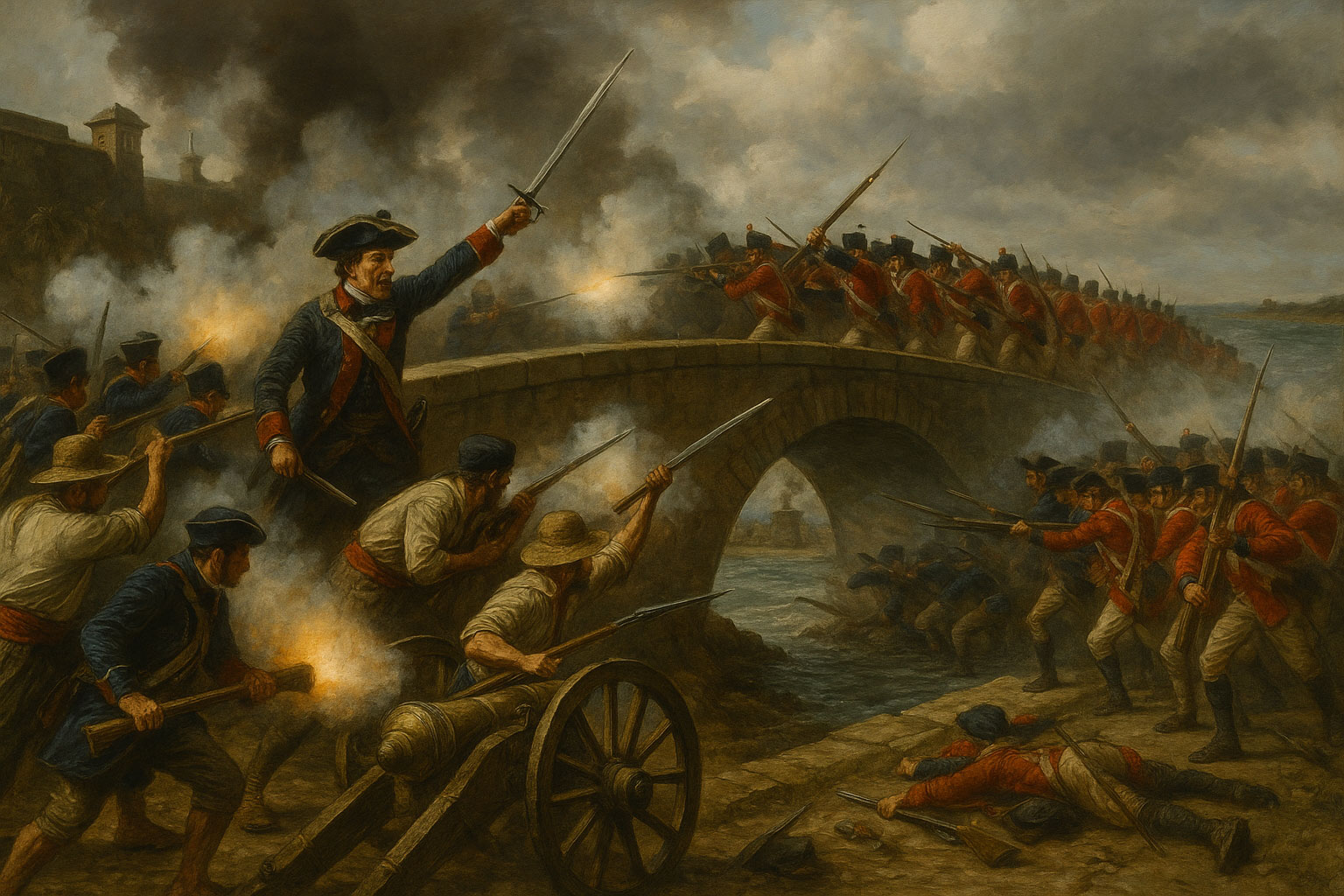
AI-generated visual of the Battle of San Antonio Bridge — where Spanish and Puerto Rican defenders held off British troops in a decisive engagement.
In the following days, Abercromby tried to advance toward San Juan. To do so, he had to cross the San Antonio bridge, the gateway to the city. There, Captain and engineer Ignacio Mascaró entrenched himself, not only organizing an effective resistance but also leading counterattacks. Simultaneously, Fort San Jerónimo, defended by Del Toro, withstood constant bombardments and infantry assaults.
The defenders’ morale grew. Each British attempt to advance was met with precise fire from the fortifications and coordinated ground attacks. Gunboats, coastal batteries, and the mobility of Spanish and allied troops demonstrated the effectiveness of the defense system.
The Ultimatum and Castro’s Response
On April 18, Abercromby and Harvey sent a parliamentarian demanding San Juan’s surrender. Brigadier Ramón de Castro replied with a letter that deserves to be remembered among the great moments in Spanish military history:
“I will defend, as I must, my Catholic King until I shed the last drop of my blood…”
And so he did. The resistance lasted until May 1. The lack of progress, troop fatigue, the climate, disease, and the relentless pressure from the fortifications convinced Abercromby to retreat. The British abandoned their positions and reembarked.
Balance and Consequences
The Spanish victory in San Juan was complete. Casualties were relatively low on the defending side, and the fortifications remained intact. The British suffered a significant moral and military blow. They would never attempt another invasion of the island.
For Spain, it was a vindication of its defensive capabilities at a time when many considered it a dying power. It was also a demonstration of unity among peninsulars, creoles, freed slaves, exiled French, and even convicts. An entire society mobilized in defense of its land.
Why This Battle Matters?
In the context of the Black Legend, this episode is particularly significant. It defies the image of a decadent, ineffective, or passive Spain. Here we see a competent administration, a committed population, and a flawless military strategy. Puerto Rico wasn’t saved by miracle or luck, but by Spanish military science and the bravery of those who stood against one of the world’s most powerful armies.
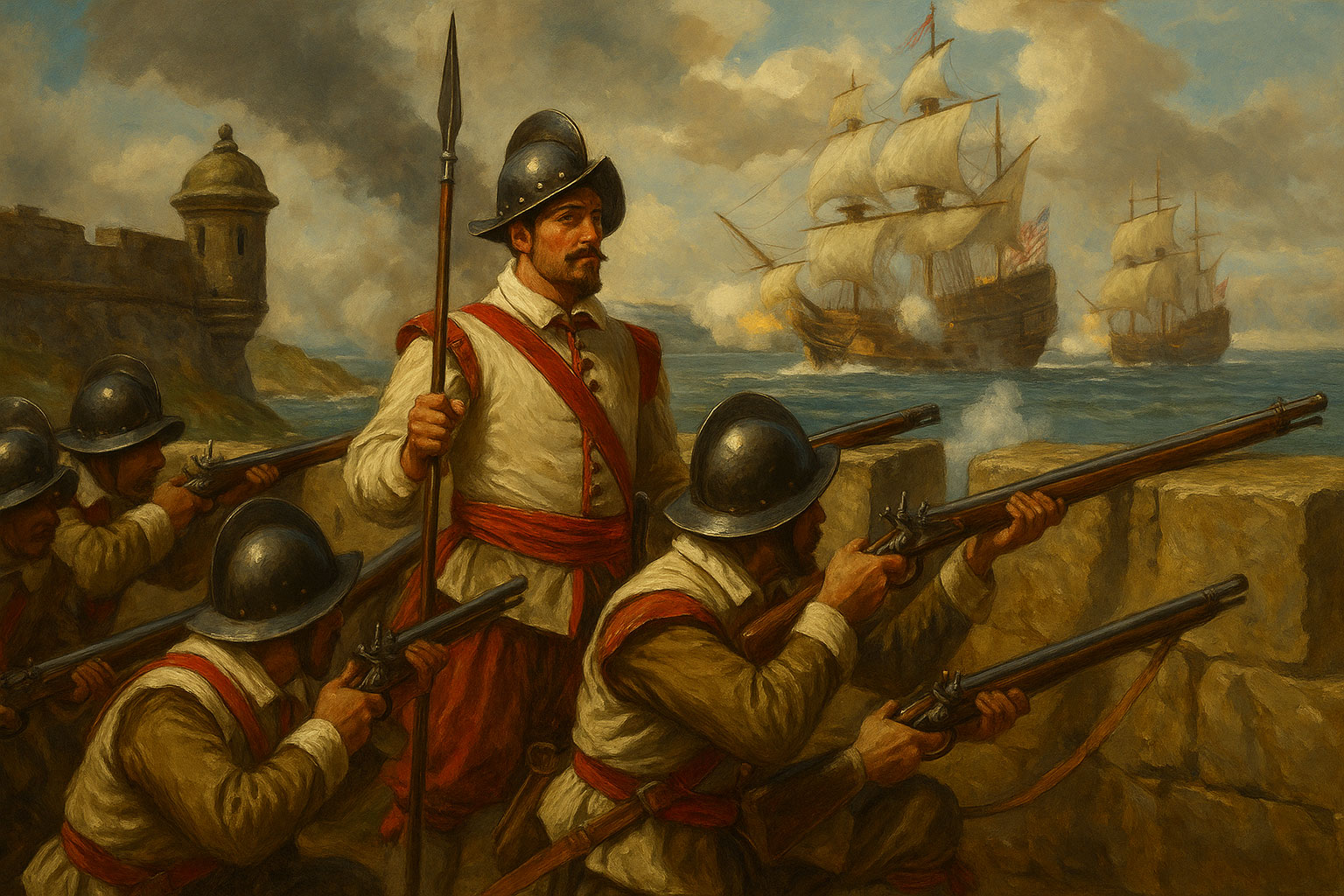
AI-generated scene portraying the British withdrawal from San Juan — a symbolic moment marking Spain’s successful defense in the Caribbean.
In fact, this campaign mirrors what had occurred more than fifty years earlier at Cartagena de Indias in 1741, when a similarly massive British force was driven back by a smaller, but strategically superior Spanish defense. In both cases, Spain showed that it could not only govern, but defend its overseas territories with honor and tactical brilliance.
Remembering the 1797 Battle of San Juan is historical justice. It shows that the Spanish Empire could also defend its territories with intelligence and resolve, and that the people overseas were not mere spectators but active protagonists of their own history.
In times when history is often simplified or ideologized, it’s worth recovering these pages that, without falling into empty apologetics, reveal a complex, rich, and proud reality.
Because on that May 1st of 1797, Puerto Rico not only defended its land: it defended Spain’s honor in the Caribbean. And it won.
Sources
- Zapatero, J. M. (1959). De la batalla del Caribe: El último ataque inglés a Puerto Rico (17 de abril a 1 de mayo de 1797). Revista de Historia Militar, Nº 4.
- Archivo General Militar de Segovia. (1797). Documentación sobre la defensa de Puerto Rico durante el ataque británico de 1797. Legajo 36, Sección Ultramar.
- Velázquez, M. C. (1950). El estado de guerra en Nueva España, 1760–1808. México: Instituto de Investigaciones Históricas.
- Brau, S. (1917). Historia de Puerto Rico. Nueva York: Imprenta de J. J. Little & Ives.
- Hostos, A. (1948). Ciudad murada: Ensayo sobre el proceso de civilización de la ciudad española de San Juan Bautista de Puerto Rico. La Habana: Editorial Lex.
- Hoyt, E. A. (1943). A History of the Harbor Defenses of San Juan P. R. Under Spain: 1509–1898. Puerto Rico Coast Artillery Command.
- Fisher, H. A. L. (1935). A History of Europe (Vol. 2). Cambridge: Cambridge University Press.
Share this article
On this day
- 1690 The excellent Baroque painter Juan de Valdés Leal, nemesis of Murillo and famous for his "Vanitas" in the Hospital de la Caridad, dies in Sevilla.
- 1940 At dawn, Lluís Company y Jover, President of the Generalitat de Catalunya, is shot by a picket of soldiers at Montjuic Castle for the crime of military rebellion.
History of Spain